Adriana Musteata and Victoria Musteata
Moldova
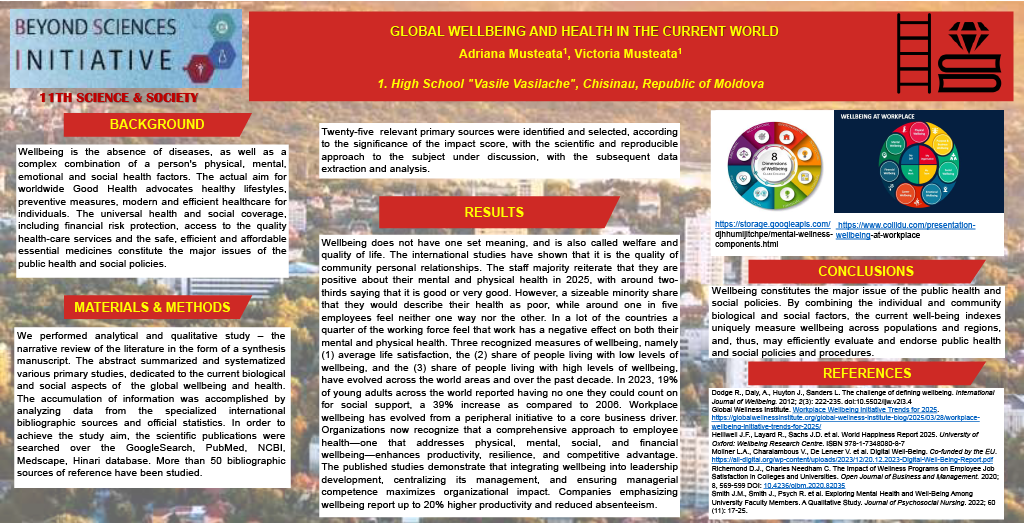
Global wellbeing and health in the current world
Adriana Musteata1, Victoria Musteata1
1. High School “Vasile Vasilache”, Chisinau, Republic of Moldova
Abstract
Background
Wellbeing (WB) is the absence of diseases, as well as a complex combination of a person’s physical, mental, emotional and social health factors. The actual aim for worldwide Good Health advocates healthy lifestyles, preventive measures, modern and efficient healthcare for individuals. In 2023, 19% of young adults across the world reported having no one they could count on for social support, a 39% increase as compared to 2006. Worldwide a quarter of the working force feel that work has a negative effect on both their mental and physical health. The universal health and social coverage, including financial risk protection, access to the quality health-care services and the safe, efficient and affordable essential medicines constitute the major issues of the public health and social policies.
Methods
We performed the analytical study — a narrative review of the literature in the form of a synthesis manuscript. The abstract systematized various primary studies, dedicated to the current aspects of the global wellbeing and health. The accumulation of information was accomplished by analyzing data from the specialized international bibliographic sources and official statistics. In order to achieve the study aim, the scientific publications were searched over the Google Search, PubMed, NCBI, Medscape, Hinari database.
Results
The staff majority reiterate that they are positive about their mental and physical health in 2025, with around two-thirds saying that it is good or very good. A sizeable minority share that they would describe their health as poor. Three recognized measures of WB, namely average life satisfaction, the share of people living with low levels of WB, and the share of people living with high levels of WB, have evolved across the world areas and over the past decade. Organizations now recognize that a comprehensive approach to employee health–one that addresses physical, mental, social, and financial WB–enhances productivity, resilience, and competitive advantage. The published studies demonstrate that integrating WB into leadership development, centralizing its management, and ensuring managerial competence maximizes organizational impact. Companies emphasizing WB report up to 20% higher productivity and reduced absenteeism.
Conclusions
By combining the individual and community biological and social factors, the current well-being indexes uniquely measure WB across populations and regions, and, thus, may efficiently evaluate and endorse public health and social policies and procedures.
Leave A Comment