
Emmanuel Fajemisin
South Africa
Antibody Bioconjugates as targeted therapeutics for CD64+ dysfunctional monocytes/macrophages implicated in cancer types.
Emmanuel Adebowale Fajemisin 1, Olusiji Alex Akinrinmade 1, 2 , Stefan Barth 1,3.
1 Medical Biotechnology and Immunotherapy Research Unit, Institute of Infectious Disease and Molecular Medicine, Faculty of Health Sciences, Universityof Cape Town, Cape Town 7700, South Africa.
2 Department ofMolecular Pharmacology, Albert Einstein College of Medicine,Bronx, New York 10461, United States.
3 NRF Research Chair in Cancer Biology, Faculty of Health Sciences, Department of Integrative Biomedical Sciences , University of Cape Town, Cape Town 7700, South Africa.
Abstract
Background
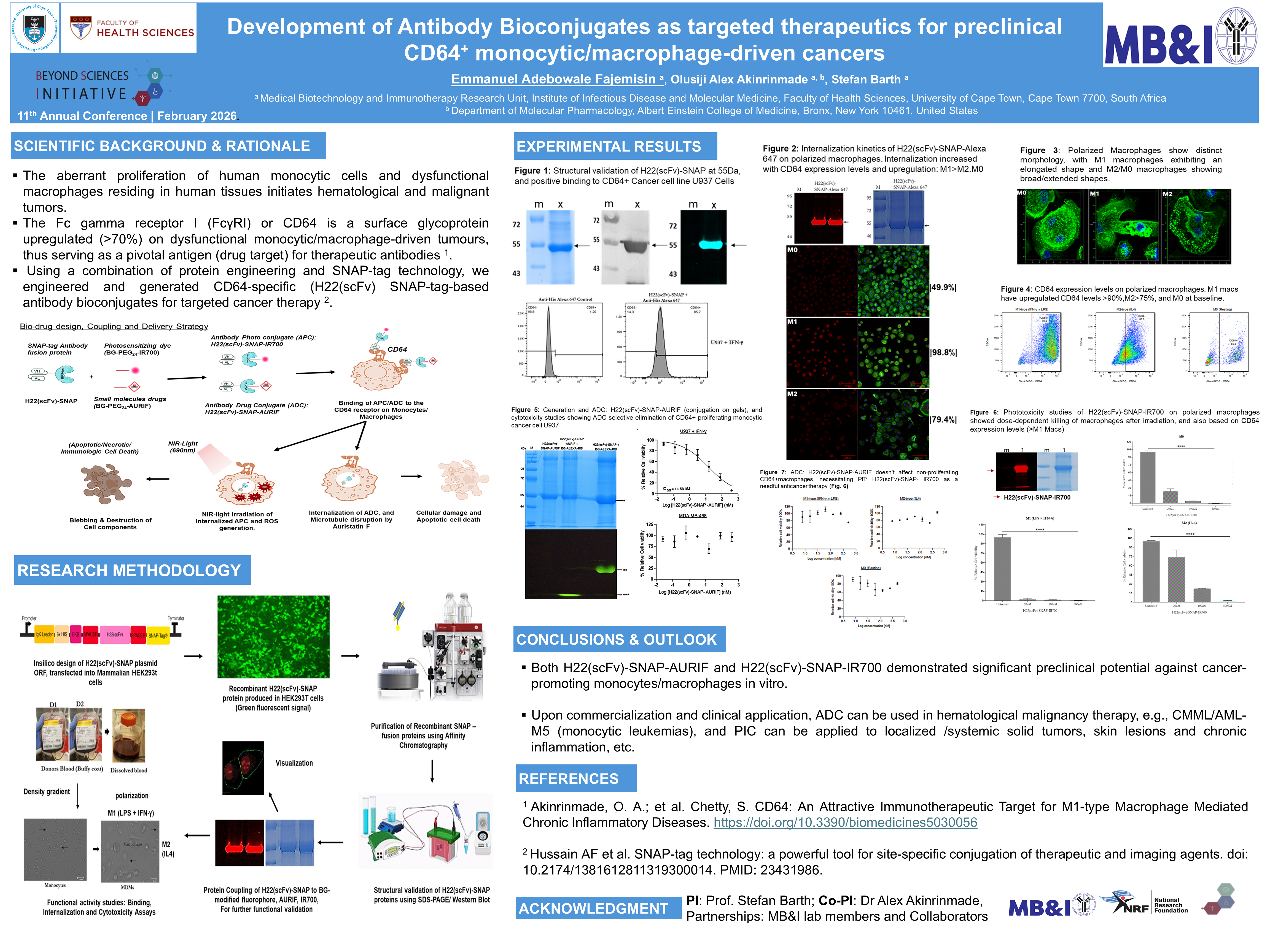
Dysfunctional human-derived monocytes/macrophages are implicated in the pathogenesis of several cancers, either haematological or solid tumours. Unfortunately, there exists an urgent need for the generation of more effective targeted therapeutics that selectively eliminate proliferating monocytes and tumour-associated macrophages without destruction of healthy myeloid cells. Interestingly, the Fc gamma receptor I (FcγRI), or CD64, is a surface receptor expressed on normal and dysfunctional monocytes/macrophages. Hence, a combination of protein engineering and biotechnology leveraging SNAP-tag technology was used to develop antibody bioconjugates that could selectively target and eliminate cancer-promoting monocytes/macrophages. This allows chemical coupling of the CD64-specific antibody fragment (H22(scFv)) to the cytostatic drug monomethyl auristatin F (ADC) or the light-sensitive dye IR700 (PIC). Both ADC and PIC explored in this study offer superior benefits over conventional drugs or protein therapeutics like immunotoxins used previously in the treatment of cancers.
Methods
Anti-CD64 SNAP-tag proteins were expressed and structurally validated. Afterwards, they are conjugated to Auristatin F and IR700 to generate immunoconjugates, H22(scFv)-SNAP-AURIF and H22(scFv)-SNAP-IR700. Next, functional binding and cytotoxicity studies were performed on CD64+-expressing monocytic cells and polarized ex vivo macrophages prepared from human blood monocytes (hMDMs) . 500 nM maximal concentrations of ADC and PIC was used for treatment of 5×10⁵ cells seeded in 96-well plates, and dose-dependent cytotoxicity (with IC50 values/p-values) was determined using statistical analysis
Results
Recombinant full-length H22(scFv)-SNAP protein was successfully expressed and structurally validated with functional binding. With ethical approval, hMDMs were successfully prepared, polarised, and characterised. H22(scFv)-SNAP-AURIF (ADC) showed a dose-dependent killing of both IFN-γ-stimulated and unstimulated CD64+ proliferating cells. This next-generation ADC offers clinical benefits above immunotoxins due to its non-protein cytotoxic agent (AURIF) unaffected by endosomal proteases. Similarly, SNAP-tag PIC, H22(scFv)-SNAP-IR700 compromised cell viability in polarised ex vivo macrophage subtypes. Hence, this allows for selective targeting of the dominant macrophages subpopulation implicated in the specified cancers, and because IR700 is a theranostic agent, it allows for dual clinical benefits of diagnosis and therapy in a minimally invasive manner in most chronic inflammatory disease and solid cancers
Conclusions
Anti-CD64 SNAP-tag antibody conjugates demonstrate preliminary therapeutic potential against CD64+ myeloid-derived tumors.
Leave A Comment