
Soumya Majumdar
India
Targeting spinal glutamatergic pain pathways using Rutin.
Soumya Majumdar1, Sabnur Parvage1, Tuhin Bhattacharya1, Sanjit Dey1,2,3*
1. Department of Physiology, University of Calcutta, 92 APC Road, Kolkata 70009, West Bengal, India.
2. Centre for Nanoscience and Nanotechnology (CRNN), University of Calcutta.
3. Centre with Potential for Excellence in Particular Area (CPEPA), University of Calcutta, 92 APC Road, Kolkata 70009, West Bengal, India.
Abstract
Background
Chronic pain management relies heavily on the use of NSAIDs and opioids for symptomatic relief. They present adverse physiological effects and additional risks of addiction. Rutin, a ubiquitous flavonoid consisting of quercetin and rutinose, may serve this purpose.
Methods
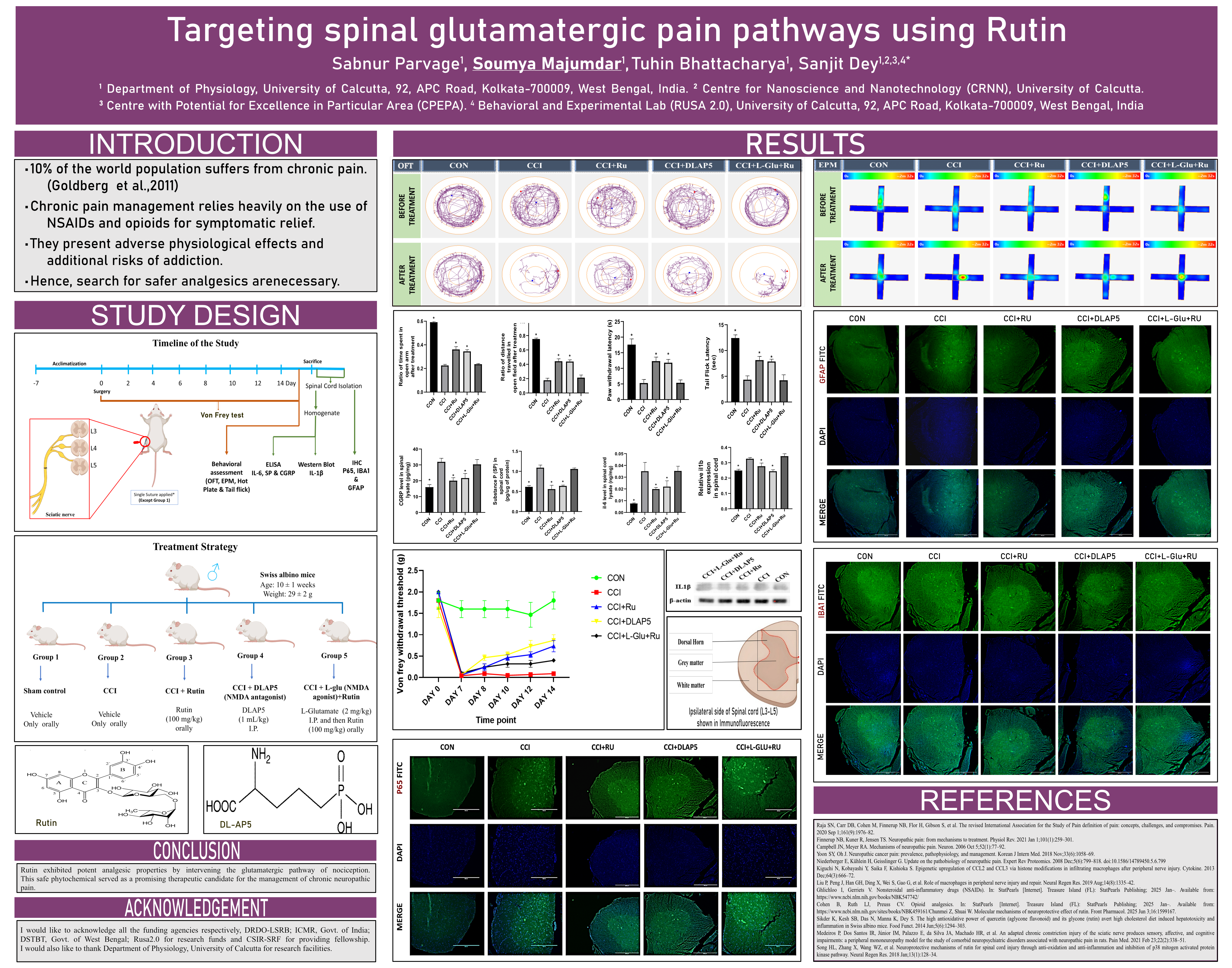
Mice were allocated into five groups: Sham Control, CCI, CCI + Rutin, CCI + DL-AP5 (DL-2-amino-5-phosphonopentanoic acid, NMDA receptor antagonist), and CCI + L-Glutamate (NMDA receptor agonist). Mechanical allodynia was evaluated by the Von Frey test. Tail-flick and hot-plate analgesiometers were used to evaluate thermal hyperalgesia. Anxiety-like behavior was assessed by the open field test and the elevated plus maze. Spinal cord lysates (L3–L5) were analyzed for antioxidant profile, substance P, calcitonin gene-related peptide (CGRP), GABA, and interleukin-6 (IL-6) via ELISA. IL-1β expression was further analyzed by Western blotting. Spinal Immunohistochemistry of COX-2, p65, IBA-1, and GFAP expressions was performed using FITC-conjugated antibodies and DAPI. All animal experiments were performed after Institutional ethics committee approval.
Results
Rutin treatment significantly improved responses in mechanical and thermal nociception tests. It alleviated pain-induced anxiety, as indicated by increased central region exploration in the OFT and increased open-arm time in the EPM. Rutin restored antioxidant profiles in the mice of pain groups. It reduced excitatory neuropeptides SP (2.5-fold) and CGRP (1.6-fold), while increasing the inhibitory neurotransmitter GABA (1.5-fold). Levels of pro-inflammatory cytokines interleukin-6 (IL-6) and interleukin-1β (IL-1β) were also decreased. This was accompanied by reduced p65 translocation and decreased levels of COX-2, IBA-1, and GFAP. Thus, our study highlights the ameliorative effect of rutin in a neuropathic chronic pain model when administered alone, but not when preceded by L-glutamate treatment. The NMDA receptor antagonist DL-AP5 could ameliorate the pain as the proof of the concept.
Conclusions
Rutin exhibited potent analgesic properties by intervening in the glutamatergic pathway of nociception. This safe phytochemical serves as a promising candidate for the management of chronic neuropathic pain.
Leave A Comment