
Hafiz Badmus
Nigeria
Gastrointestinal parasites and pathological findings in captured African giant rats (Cricetomys gambianus W.) in Ibadan, Nigeria
Badmus Hafiz Ayinde1, Olaogun Sunday Charles2, Adedokun Rahamon A. Moshood2, and Olaifa Olanrewaju Samuel3
1. Department of Crop Protection and Environmental Biology, University of Ibadan, Ibadan, Nigeria
2. Department of Veterinary Medicine, Faculty of Veterinary Medicine, University of Ibadan, Ibadan, Nigeria
3. Department of Veterinary Pathology, Faculty of Veterinary Medicine, University of Ibadan, Ibadan, Nigeria
Abstract
Background
The African giant rat (AGR) (Cricetomys gambianus) could serve as an alternative source of animal protein to fight malnutrition among the people. However, it has been reported to be a vector of zoonotic diseases as it harbours parasites of public health importance. This study was therefore aimed to investigate the prevalence of gastrointestinal parasites and histopathological findings in captured AGR in Ibadan, Nigeria.
Methods
Forty (40) sexually mature AGRs (20 females and 20 males) caught from the wild in Ibadan were housed in a fabricated metal cage (one per housing unit) for 4 weeks. A total of 40 faecal pellet samples were collected for parasitological analysis using standard methods. The rats were euthanized and postmortem examinations were carried out and tissue samples from lungs, liver, testis/epididymis were collected for histopathological analysis of the defective tissues.
Results
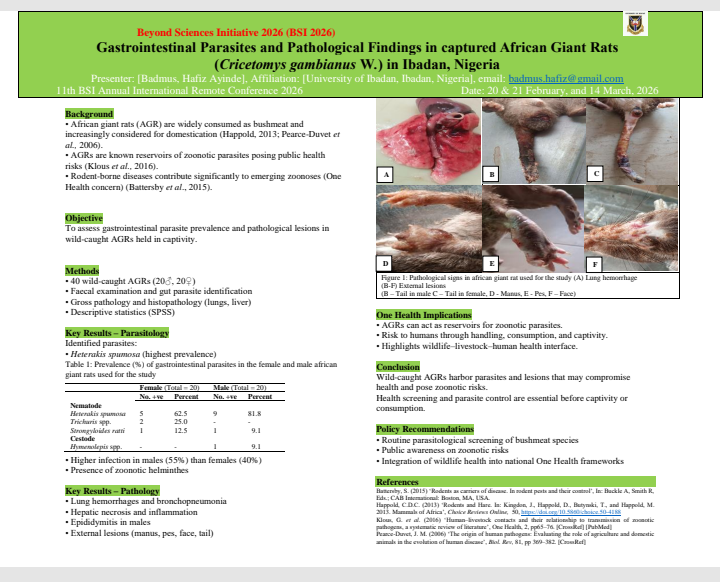
Results showed that some of the wild-caught AGRs harboured parasitic nematodes – Heterakis spumosa, Trichuris spp, and Strongyloides ratti, and cestode – Hymenolepis spp. Female AGRs were infected with H. spumosa (62.5%), Trichuris spp. (25.0%), and S. ratti (12.5%). Male AGRs were infected with H. spumosa (81.8%) and S. ratti (9.1%). Clinically, the AGRs had an inflamed manus and pes (55.0%), pus coming out from anus (45.0%), lesion at the extreme of the pinna (30.0%), different appearance of lesions around the face (25.0%). Post-mortem examination indicated hemorrhages on both lungs and inflamed epididymis. Histologically, there was vascular damage in the lungs and necrotic foci in the liver characterized by disruption of hepatic architecture.
Conclusions
AGRs harbor some gastrointestinal parasites and disease conditions which could adversely affect their keeping in captivity. It is therefore advised that the likelihood of the parasites in this rodent species should be considered in any plan for their keeping in captivity and consumption.
Leave A Comment