
Maansi Aggarwal
India
Carbonized Polymer Dot-Tannic Acid Nanoglue for Wound Healing
Maansi Aggarwal1, Deepinder Sharda2, Diptiman Choudhury2, Prolay Das1
1Department of Chemistry, Indian Institute of Technology Patna, Patna 801103, Bihar, India
2Department of Chemistry and Biochemistry, Thapar Institute of Engineering and Technology (TIET), Patiala 147004, Punjab, India
Abstract
Background
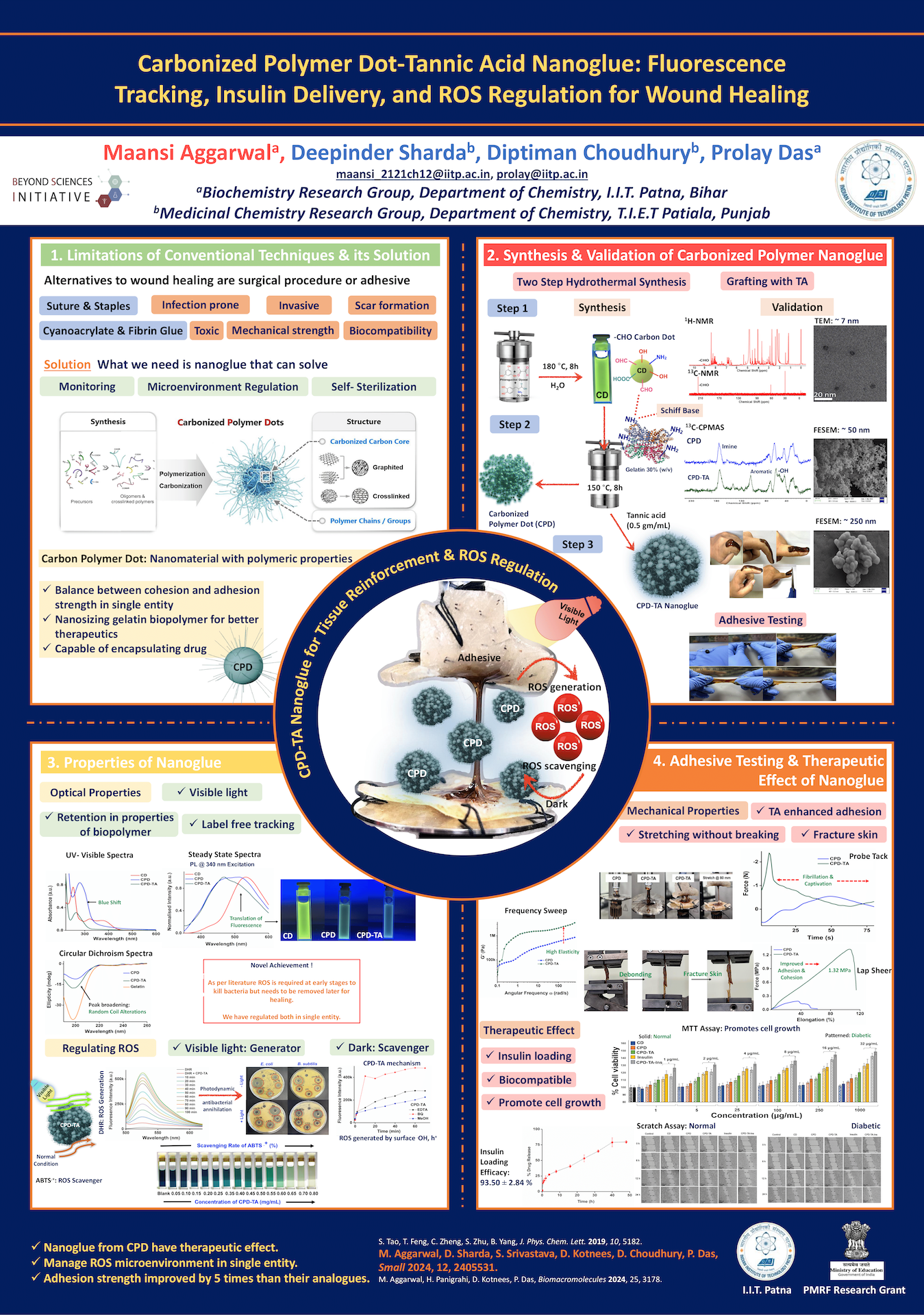
Nanotizing biosealant components offer a multitude of chemical functionalities for superior adhesion-cohesion, delivering unique properties for comprehensive wound healing that are otherwise impossible to achieve using commercial variants. For the first time, a two-step controlled hydrothermal pyrolysis is reported to nanotize dopamine, phloroglucinol, and glutaraldehyde into carbon dot (CD) to be subsequently converted into carbonized polymer dot (CPD) with gelatin as a co-substrate. Chemical crosslinking of CD with gelatin through Schiff base formation prior to the second pyrolysis step ensures a complex yet porous polymeric network. The retention of chemical functionalities indigenous to CD substrates and gelatin along with the preservation of CD photoluminescence in CPD for optical tracking was achieved. A unique nanoformulation was created with the CPD through tannic acid (TA) grafting evolving CPD-TA nanoglue demonstrating 1.32 MPa strength in lap shear tests conducted on porcine skin, surpassing traditional bioadhesives. CPD-TA nanoglue uploaded insulin as chosen cargo disbursal at the wound site for healing normal and in vitro diabetic wound models using HEKa cells with extraordinary biocompatibility. Most importantly, CPD-TA can generate reactive oxygen species (ROS) and scavenge simultaneously under ambient conditions (23 W white LED or dark) for on-demand sterilization or aiding wound recovery through ROS scavenging.
Methods
Glyoxal (3 mmol), phloroglucinol (0.5 mmol), and DL-Dopa (1 mmol) were dissolved in 7 mL DI water and reacted in a Teflon-lined autoclave at 180 °C for 8 h. The resulting dark-yellow supernatant was syringe-filtered and dialyzed (MWCO 2 kDa, 48 h) to remove impurities, yielding yellow-green fluorescent CDs (20 mg/mL), stored at 4 °C. A 30% (w/v) gelatin solution (4 mL) was prepared, mixed with 0.5 mL CD solution, stirred for 5 min, and hydrothermally treated at 150 °C for 8 h to form CPD. CPD (2 mL) was combined with TA solution (0.5 g/mL) in volumes of 300 μL, 500 μL, and 800 μL at pH 8 to produce varying CPD-to-TA ratios for adhesion studies.
Results
DL-Dopa, phloroglucinol, and glutaraldehyde were co-nanotized to create multifunctional CD with adhesion-relevant groups while eliminating free-aldehyde toxicity. Control studies showed that directly mixing the precursors with gelatin failed to yield an effective bioglue, confirming the need for nanotization. CPD-TA was produced via TA grafting, verified by TEM and FESEM, and physico-mechanical tests (rheology, probe tack, lap shear) demonstrated an optimized adhesion–cohesion balance with 1.32 MPa strength. CPD-TA exhibited strong photoluminescence for optical tracking and enabled effective insulin loading and delivery. Combination-index analysis revealed synergistic wound-healing performance, supported by cell-migration, antibacterial, and cytocompatibility assays. Notably, CPD-TA generated ROS under visible light for self-sterilization and scavenged ROS in darkness, enabling dual-mode therapeutic functionality.
Conclusions
Significant efforts in biosealants aim to achieve non-toxicity, strong adhesion–cohesion, and localized drug delivery. Synthetic polymers offer strength but risk inflammation, while natural polymers are safer but weak. We hypothesized a non-toxic, high-performance biosealant using a natural polymer reinforced by nanotization. Dopamine, phloroglucinol, and glutaraldehyde were co-pyrolyzed to form multifunctional carbon dots (CDs) retaining –OH, –NH₂, and –CHO groups, then conjugated with gelatin and subjected to a second pyrolysis step to generate CPD, preserving PL and functional groups critical for adhesion. Grafting CPD with tannic acid produced a porous, non-cytotoxic nanoglue (CPD-TA) supporting drug loading, PL tracking, and strong adhesion–cohesion. Remarkably, CPD-TA generates bactericidal ROS under low-power LED irradiation and scavenges ROS in darkness, aligning with wound-healing needs. This platform showed excellent performance in a diabetic wound model.
Leave A Comment