
Oluwatosin Ajibade
Nigeria
Bacterization-Mediated Growth Enhancement in Amaranthus hybridus Seeds
Oluwatosin Ajibade 1 & Olubukola Oyawoye 2
1. Department of Microbiology, Adeleke University, Ede, Osun State, Nigeria
Abstract
Background
Growing global populations demand increased food production despite shrinking arable land. Conventional agriculture’s dependence on agrochemicals threatens environmental and human health, making plant growth-promoting rhizobacteria (PGPR) an attractive sustainable alternative. Vegetables provide affordable, essential nutrients including vitamins, fiber, antioxidants, and proteins, while offering documented medicinal benefits. This study investigates PGPR application to enhance growth parameters of Amaranthus hybridus, a nutritionally and economically valuable leafy vegetable commonly consumed as soup in Nigeria, demonstrating the potential of beneficial bacteria to improve crop yields through eco-friendly agricultural practices
Methods
The isolated bacteria were screened for plant growth-promoting properties, including phosphate solubilization, indole-3-acetic acid (IAA) production, ammonia production, catalase activity, hydrocyanic acid (HCN) production, and siderophore production. Selected isolates exhibiting plant growth-promoting characteristics were used to bacterize seeds of Amaranthus hybridus through immersion of surface-sterilized seeds in bacterial suspensions. Whole genome sequencing of the selected isolates was performed using the RAST (Rapid Annotation using Subsystem Technology) software platform. Functional and structural analyses of predicted proteins were conducted using the I-TASSER (Iterative Threading ASSEmbly Refinement) consolidated bioinformatics package
Results
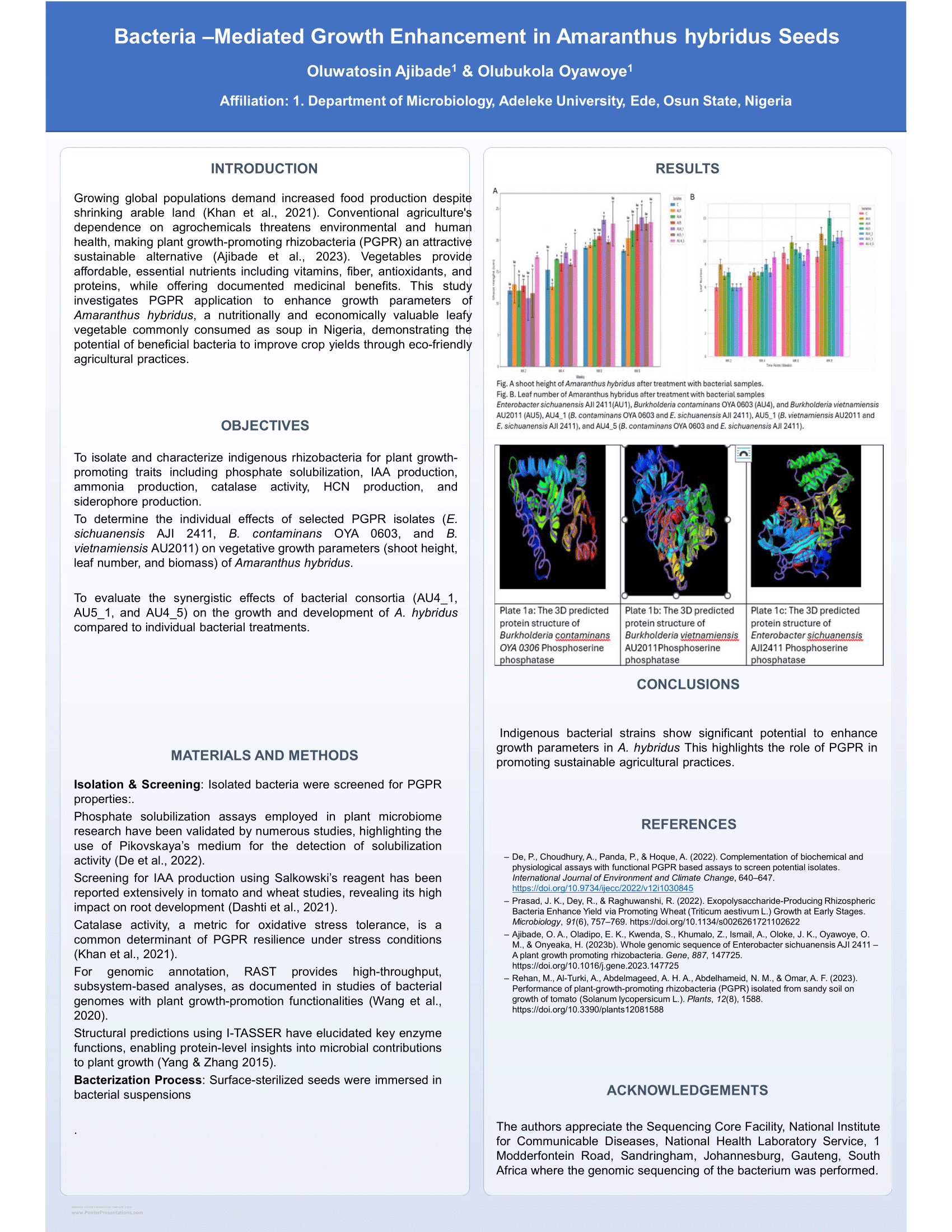
The plant growth-promoting rhizobacteria (PGPR) employed in this study were Enterobacter sichuanensis AJI 2411(1), Burkholderia contaminans OYA 0603 (4), and Burkholderia vietnamiensis AU2011 (5). These isolates were applied both individually and as bacterial consortia. Three consortia combinations were formulated: AU4_1 (B. contaminans OYA 0603 and E. sichuanensis AJI 2411), AU5_1 (B. vietnamiensis AU2011 and E. sichuanensis AJI 2411), and AU4_5 (B. contaminans OYA 0603 and E. sichuanensis AJI 2411).
Statistical analysis revealed significant differences in growth parameters at the 95% confidence level (p < 0.05). Consortium AU4_1 produced the highest shoot height at 23.66 cm, representing a statistically significant increase compared to the control. The maximum leaf number was observed for consortium AU5_1 at 10.33 leaves, which was significantly higher than the control group at 8.66 leaves (p < 0.05).
Conclusions
This study demonstrates that indigenous bacterial strains E. sichuanensis AJI 2411, B. contaminans OYA 0603, and B. vietnamiensis AU2011 exhibit substantial potential for enhancing growth parameters of A. hybridus.
Leave A Comment