
Doralice Da Paz Neta
Brazil
Transcriptional Profiles and Clinical Implications of SIGLEC Receptors in Osteosarcoma
Doralice Conceição da Paz Neta 1, Vitor Lins dos Santos 2, Bárbara de Oliveira Silva 3, Michelly Cristiny Pereira 4
1. Research Center for Therapeutic Innovation, University Federal of Pernambuco
2. Research Center for Therapeutic Innovation, University Federal of Pernambuco
3. Research Center for Therapeutic Innovation, University Federal of Pernambuco
4. Research Center for Therapeutic Innovation, University Federal of Pernambuco
Abstract
Background
Osteosarcoma is a rare and aggressive malignant bone cancer, usually located in the epiphyses of long bones, mainly affecting children and adolescents. Despite its low incidence, it has a high mortality rate and unfavorable prognosis, with pulmonary metastasis being the main cause of death. SIGLECs are transmembrane glycan recognition proteins expressed in various cells of the immune system. Different SIGLECs interact with specific sialoglycans, triggering essential cellular responses. When aberrantly expressed in tumor cells, they can promote cancer growth and progression. Thus, investigating their expression in osteosarcoma to identify potential biomarkers becomes relevant. The objective of this work is to evaluate the expression of SIGLEC family proteins in osteosarcoma samples, using public data from the TARGET-OS database.
Methods
This is a retrospective observational study with a bioinformatics approach, using public data from the TARGET-OS project (Therapeutically Applicable Research to Generate Effective Treatments – Osteosarcoma). Raw gene expression data (bulk RNA-Seq) and metadata were analyzed in RStudio using the TCGAbiolinks package. A normalized expression matrix in TPM (Transcripts Per Million) was also created. The analysis of differentially expressed genes (DEGs), focusing on SIGLECs, considered two subgroups: presence or absence of metastasis and patients’ vital status. Complementarily, Kaplan-Meier analyses were performed to assess the relationship between SIGLEC expression levels and survival.
Results
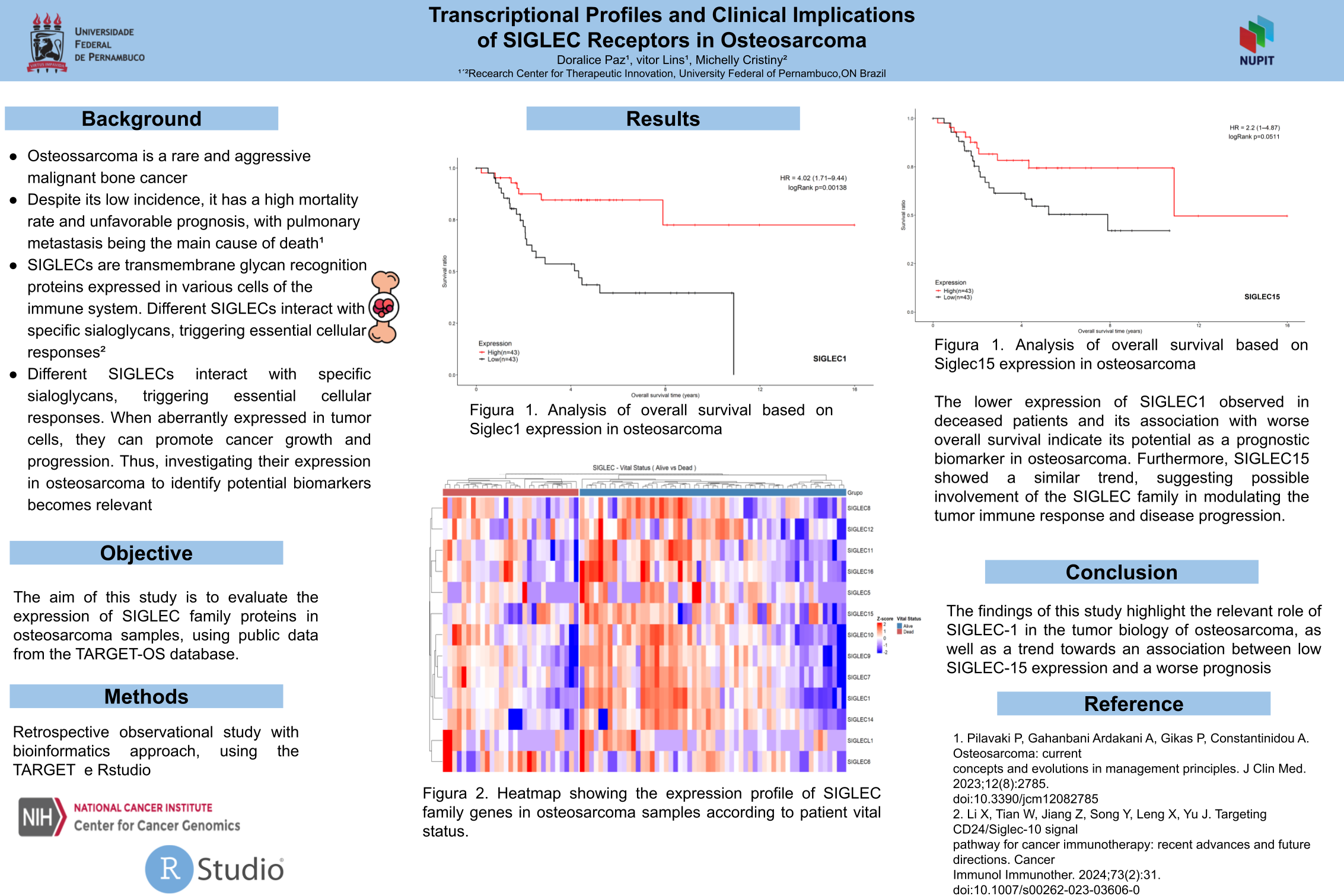
SIGLEC-1 showed significantly reduced expression when comparing living and deceased patients (logFC = -1.19), and patients with low expression of this receptor had an approximately four times greater risk of death compared to those with high expression (HR = 4.02; 95% CI: 1.71–9.44; p = 0.001), indicating its potential as a negative prognostic marker in osteosarcoma. None of the SIGLECs showed significant variation between patients with and without metastasis, suggesting a role more related to the patient’s immune status than to the metastatic capacity of the tumor. Furthermore, a trend towards an association between low SIGLEC-15 expression and lower overall survival was observed (HR = 2.2; 95% CI: 1–4.87; p = 0.05), reinforcing its possible clinical value.
Conclusions
The findings of this study highlight the relevant role of SIGLEC-1 in the tumor biology of osteosarcoma, as well as a trend towards an association between low SIGLEC-15 expression and a worse prognosis. Although the results reinforce the potential of these molecules as prognostic biomarkers, further studies are needed to validate and deepen these findings.
Leave A Comment