
Ceban Victor
Moldova
PERIODONTAL DISEASE — IN-DEPTH TISSUE REACTIONS IN COMBINED THERAPEUTIC AND PROSTHETIC TREATMENT
Ceban Victor1, Ceban Mariana2, Marcu Diana3, Corlotean Ecaterina1, Marinov Vladimir1
1 1st year, Post-graduate Resident Physician in prosthodontics, Department of Orthopedic Dentistry „Iarion Postolachi”, Nicolae Testemitanu State University of Medicine and Pharmacy of the Republic of Moldova
2 University Assistant, Department of Orthopedic Dentistry „Iarion Postolachi”, Nicolae Testemitanu State University of Medicine and Pharmacy of the Republic of Moldova
3 Associate Professor, PhD, department of odontology and periodontology “Sofia Sîrbu”, Nicolae Testemitanu State University of Medicine and Pharmacy of the Republic of Moldova
Abstract
Background
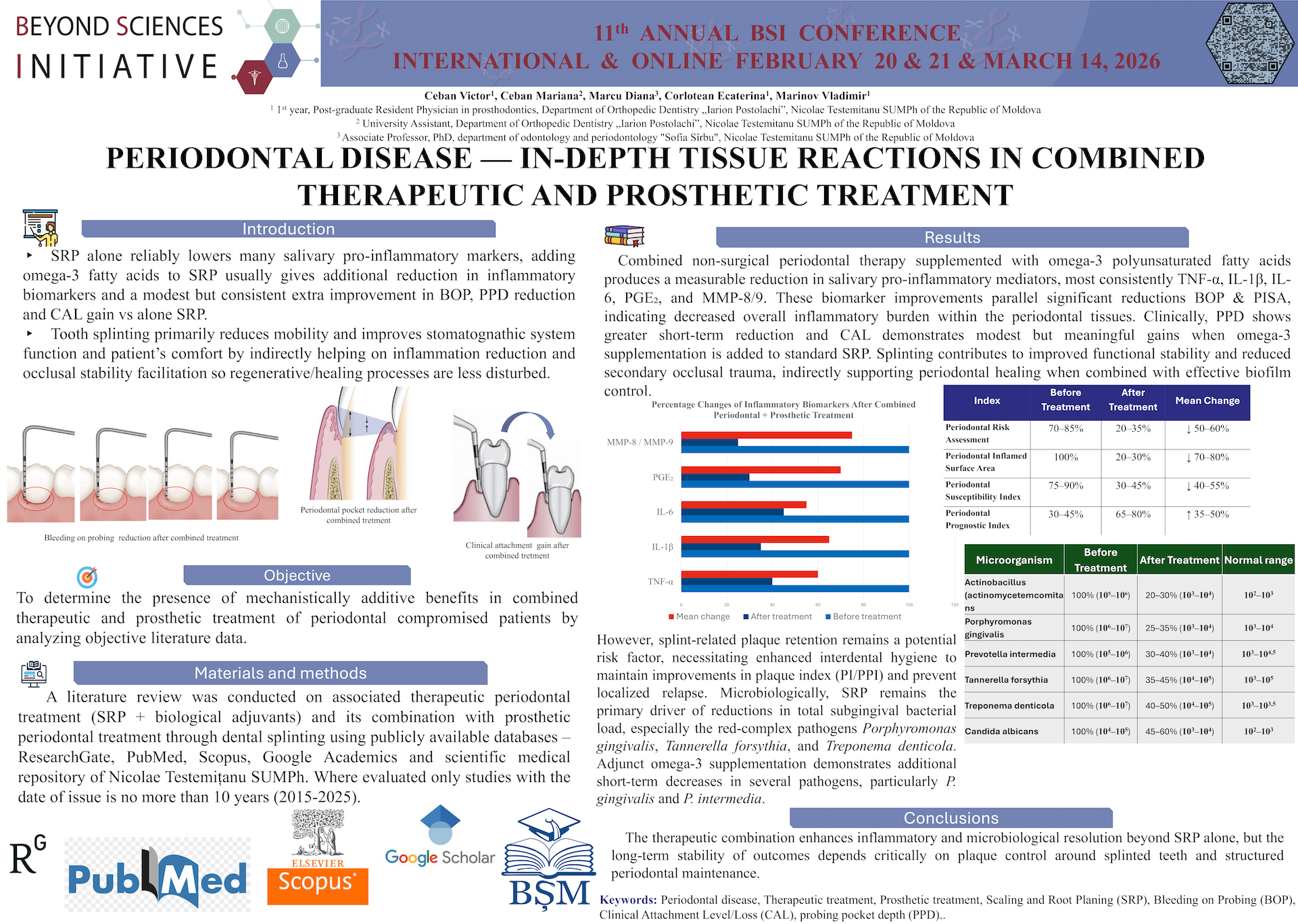
SRP alone reliably lowers many salivary pro-inflammatory markers, adding omega-3 fatty acids to SRP usually gives additional reduction in inflammatory biomarkers and a modest but consistent extra improvement in BOP, PPD reduction and CAL gain vs alone SRP. Tooth splinting primarily reduces mobility and improves stomatognathic system function and patient’s comfort by indirectly helping on inflammation reduction and occlusal stability facilitation so regenerative/healing processes are less disturbed.
Methods
A literature review was conducted on associated therapeutic periodontal treatment (SRP + biological adjuvants) and its combination with prosthetic periodontal treatment through dental splinting using publicly available databases – ResearchGate, PubMed, Scopus, Google Academics and scientific medical repository of Nicolae Testemițanu SUMPh. Where evaluated only studies with the date of issue is no more than 10 years (2015-2025).
Results
Combined periodontal therapy with omega-3 supplementation reduces major salivary inflammatory markers and lowers BOP and PISA, indicating improved periodontal health before prosthetic stabilization. Clinically, PPD reduction and modest CAL gain are enhanced when omega-3 is added to SRP. Semi-permanent splinting provides essential functional stability for mobile teeth, limiting secondary occlusal trauma and creating a more favorable mechanical environment for tissue healing and future prosthetic planning. However, splints can increase plaque retention, making meticulous hygiene indispensable to preserve gains in PI/PPI and prevent localized relapse. Microbiologically, SRP drives major reductions in total bacterial load and red-complex pathogens, while omega-3 yields additional short-term decreases in P.gingivalis and P.intermedia. A.actinomycetemcomitans may persist in protected niches, and C.albicans generally remains unchanged but may increase around inadequately cleaned splints.
Conclusions
The therapeutic combination enhances inflammatory and microbiological resolution beyond SRP alone, but the long-term stability of outcomes depends critically on plaque control around splinted teeth and structured periodontal maintenance.
Leave A Comment