
Valeriia Kolotusha
Ukraine
EFFICACY OF THE THYROID FINE-NEEDLE ASPIRATION CYTOLOGY: RETROSPECTIVE ANALYSIS WITH CORRELATION
Kolotusha V.1, Khoperiya V.2, Zinchenko N. 2
1.Taras Shevchenko National University of Kyiv, 64/13, Volodymyrska St., Kyiv, Ukraine, 01601, office@knu.ua
2.SIS “RPC PCM” SAD, 5, Verkhnya St., Kyiv, Ukraine, 01014, clinicgovua@gmail.com
Abstract
Background
thyroid nodules are a common health concern worldwide, with detection rates reaching up to 65% in the general population. However, the risk of these nodules being cancerous ranges from 7% to 15%. The European Thyroid Association recognizes fine needle aspiration biopsy (FNA) as a second-line diagnostic tool under certain conditions. The main purpose of this method is to identify thyroid nodules for further surgical treatment, while avoiding unnecessary surgery in the absence of a neoplastic process
Methods
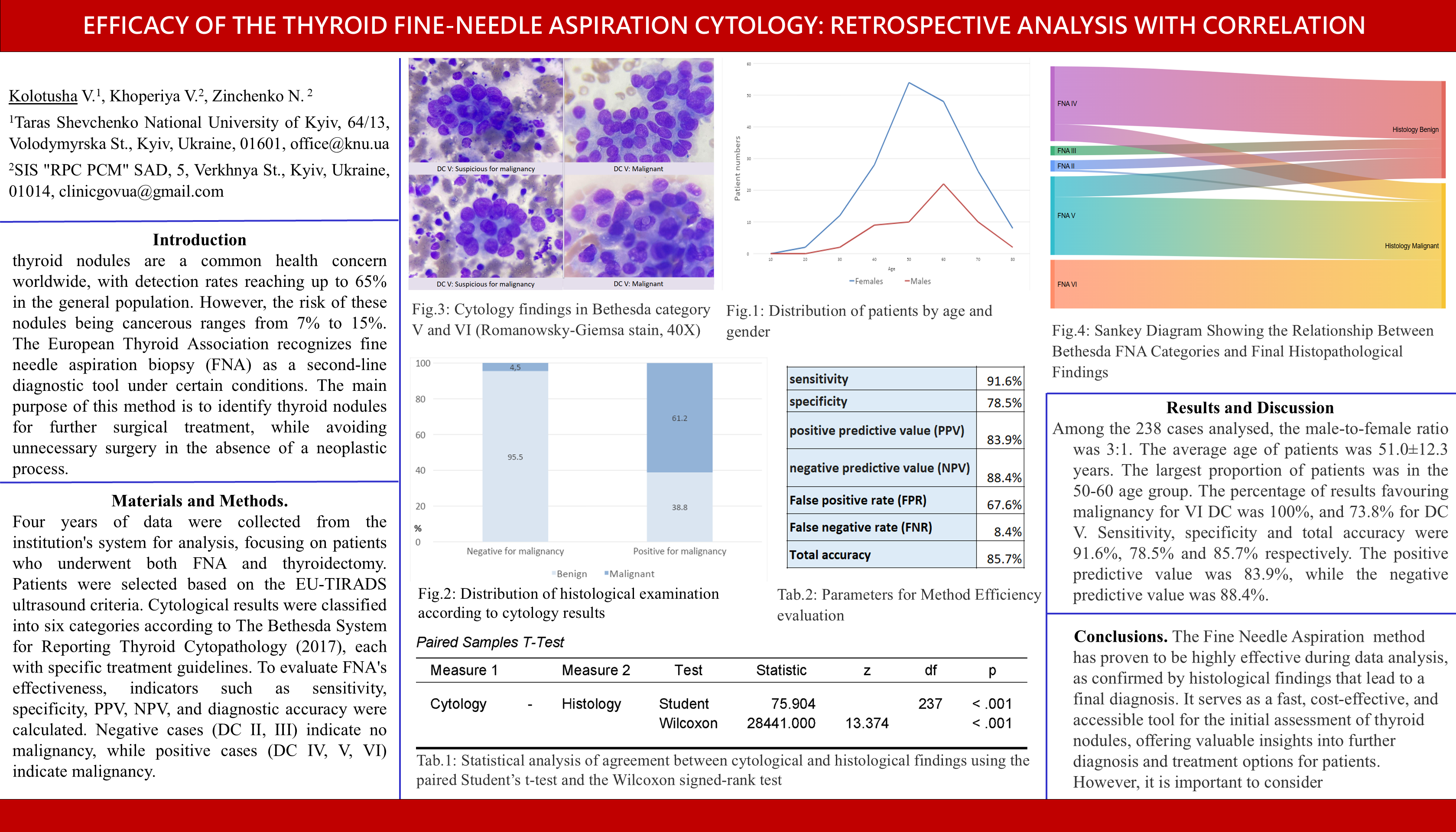
four-year data were taken from the institution’s data system and collected into one sheet for further analysis. Research included patients who underwent both FNA and thyroidectomy at the same institution. Patients undergoing primary FNA were selected based on the EU-TIRADS system ultrasound criteria. Cytological investigation results are classified into six diagnostic categories according to The Bethesda System for Reporting Thyroid Cytopathology (2017), each with specific treatment guidelines.
To assess the effectiveness of fine needle aspiration (FNA) as an independent method, indicators such as sensitivity, specificity, positive predictive value (PPV), negative predictive value (NPV), and diagnostic accuracy were calculated. A diagnostically negative case indicates no malignancy (DC II, III), while a positive case indicates malignancy (DC IV, V, VI). Positive cases follow criteria IV, V, VI, and negative cases follow criteria II, III.
Results
among the 238 cases analysed, the male-to-female ratio was 3:1. The average age of patients was 51.0±12.3 years. The largest proportion of patients was in the 50-60 age group. The percentage of results favouring malignancy for VI DC was 100%, and 73.8% for DC V. Sensitivity, specificity and total accuracy were 91.6%, 78.5% and 85.7% respectively. The positive predictive value was 83.9%, while the negative predictive value was 88.4%.
Conclusions
the Fine Needle Aspiration (FNA) method has proven to be highly effective during data analysis, as confirmed by histological findings that lead to a final diagnosis. It serves as a fast, cost-effective, and accessible tool for the initial assessment of thyroid nodules, offering valuable insights into further diagnosis and treatment options for patients. However, it is important to consider the specific circumstances of the institution where the FNA is performed, as these factors can influence the diagnostic approach.
Leave A Comment