
Syeda Hashmi
Pakistan
Proteomics of Viperid Snakes of Pakistan: A Global Health Concern
Syeda Uroosa Hashmi and Syed Abid Ali
Third World Center for Science and Technology, H.E.J. Research Institute of Chemistry, University of Karachi, Karachi-75270, Pakistan
Abstract
Background
Snake bite is one of the most neglected public health issues. The incidence of snake bite has been reported maximum in poor and rural communities. Snake bite cases vary in different countries depending largely on seasons and geographical location. Statistical data provided by WHO states that per year more than 5.5 million peoples are bitten by snakes worldwide. Snakebite is greater in African and Asian countries, especially in Pakistan as there are at least 72 known species of snakes that inhabit in different parts of the country. Up to 8,000 casualties occur by snakebites each year in the province of Sindh alone, with most of these cases being reported from the arid Thar district. Russell’s (D. russelii) and Saw-scaled (E. carinatus) vipers are the major viperid, along with two elapids Cobra (N. naja) and Krait (B. caeruleus) constitute the “Big-4 snakes” of Pakistan, and responsible for large number of mortality and morbidity cases in South Asia. So far, administration of antivenom is the only effective treatment available for snakebite envenomation, which is even not sufficiently produced within the country and thus imported from India and Saudi Arabia.
Methods
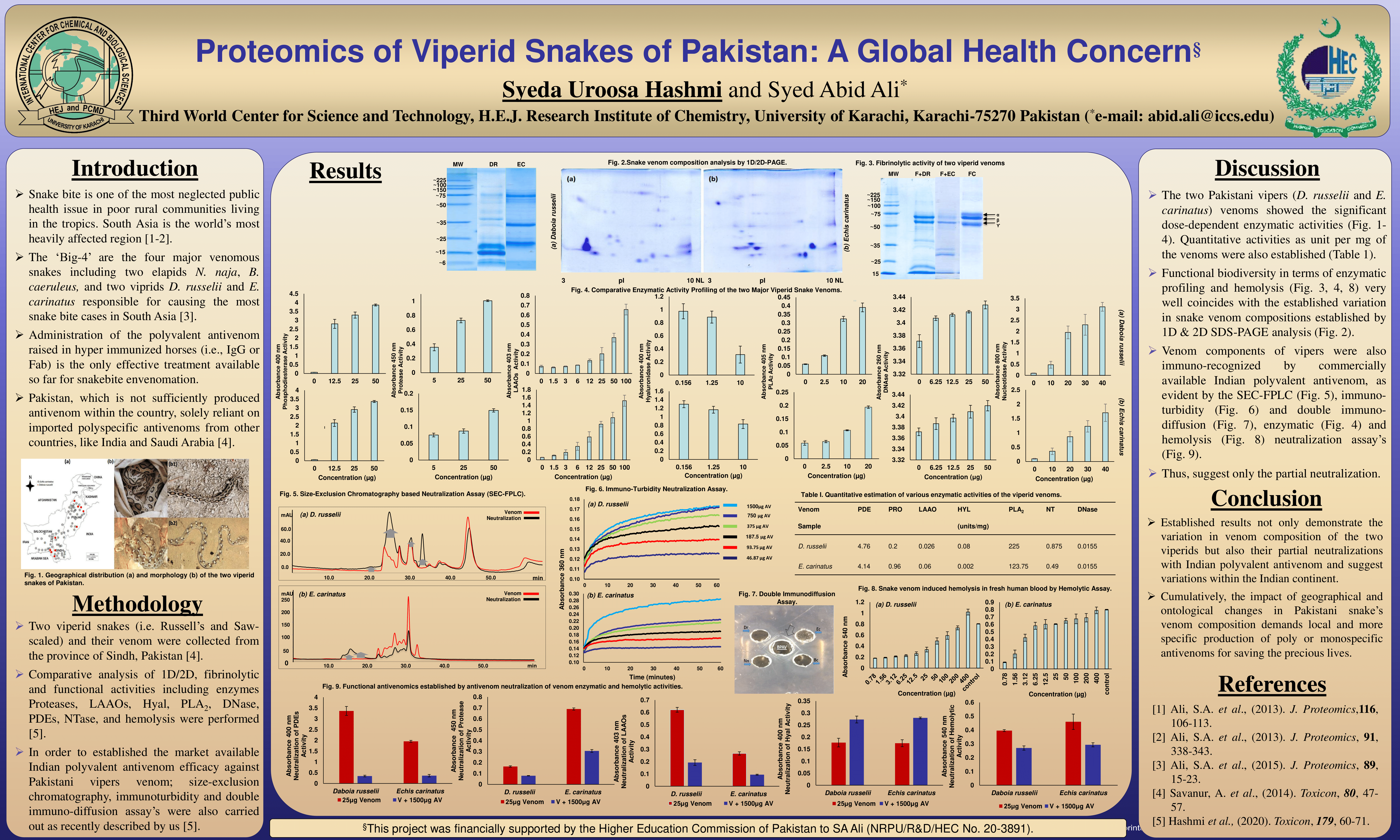
In the present study intend to explore the venom composition of the viperid (D. russelli and Echis carinatus) snakes of Pakistan by 1D/2D SDS-PAGE analysis. Functional screening of venoms was performed by different enzymatic assays including fibrinolytic, phospholipase A2, hyaluronidase, L-amino acid Oxidase, DNAse, nuclotidase, phosphodiesterase and protease assays. Turbidometric analysis was used evaluate the blood coagulation cascade. Antivenom neutralization enzymatic assays were determined by using the market available polyvalent antivenom (Bharat Polyvalent Antivenom, BPAV). Further efficacy of same antivenom was evaluated through SEC-FPLC and immunodiffusion method.
Results
Preliminary proteomics shows the inter and intraspecies venom variations among two viperids as can be evident by the appearance of bands and spots at 1D and 2D. Established functional venomics revealed, the presence of different enzymatic (i.e., proteases, PDEs, PLA2, hyaluronidase, LAAOs, AChEs, and DNases) activities of the two venoms and correlates well with the clinical manifestations of viperid snakes which includes renal failure, intravascular hemolysis, coagulopathy and hemorrhage etc. While neutralization studies using Bharat polyvalent antivenom exhibits the partial cross-reactivity and/or neutralization against two Pakistani viperid snakes.
Conclusions
Obtained results illustrate the variation in the composition of snake venom belonging from the same family-Viperidae. Moreover, market available antivenom (BPAV) showed partial neutralization against two snake venoms, thus clearly suggest the impact of geographical and ontological changes in Pakistani snake’s venom composition and demands local production of poly/monospecific antivenoms for saving the precious lives and to reduce causalities due to snakebite.
Leave A Comment