bruno cesca
Argentina
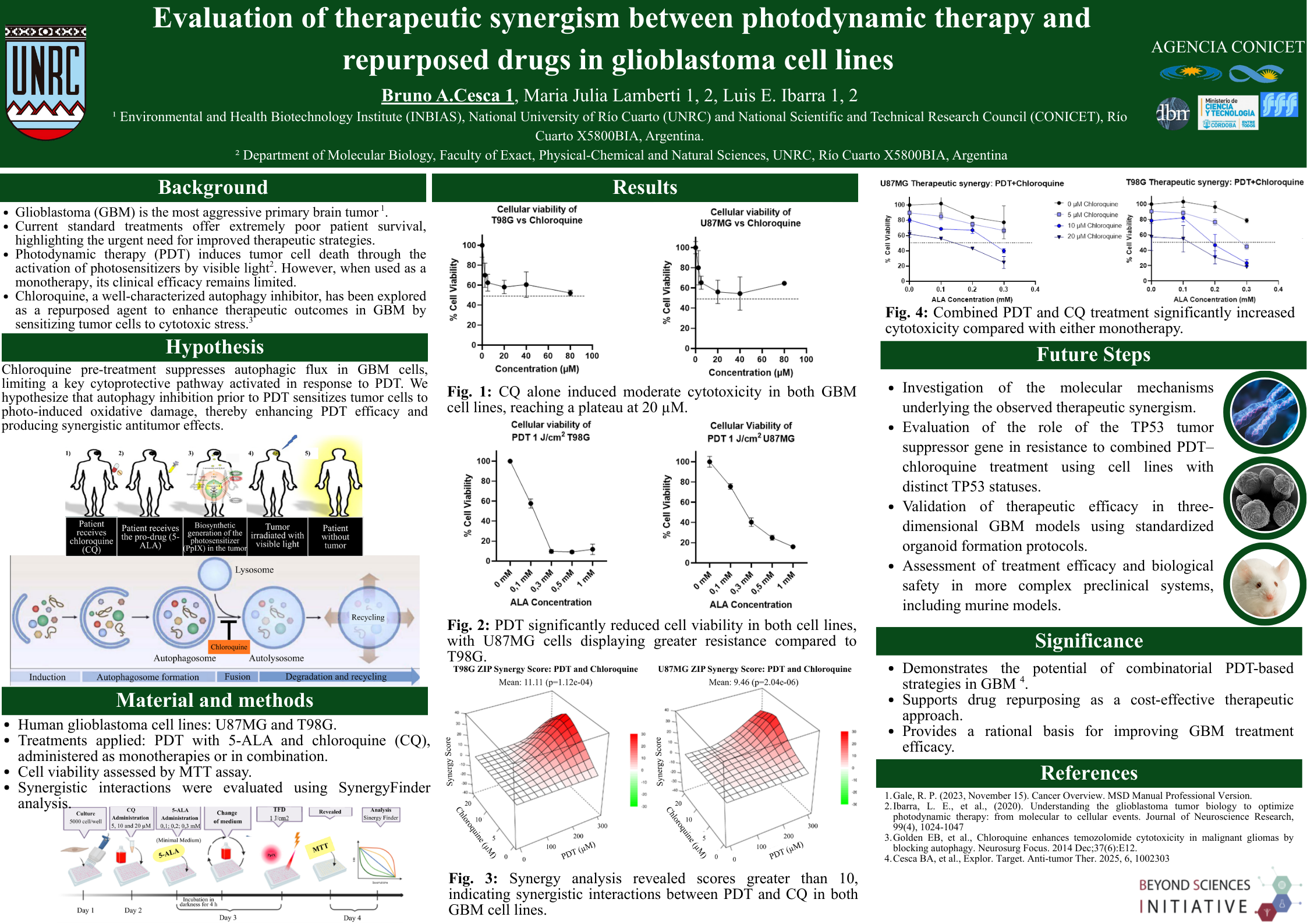
Evaluation of therapeutic synergism between Photodynamic Therapy and repurposed drugs in Glioblastoma cell lines
Bruno A.Cesca 1, Maria Julia Lamberti 1, 2, Luis E. Ibarra 1, 2
¹ Environmental and Health Biotechnology Institute (INBIAS), National University of Río Cuarto (UNRC) and National Scientific and Technical Research Council (CONICET), Río Cuarto X5800BIA, Argentina.
² Department of Molecular Biology, Faculty of Exact, Physical-Chemical and Natural Sciences, UNRC, Río Cuarto X5800BIA, Argentina
Abstract
Background
Glioblastoma (GBM) is one of the most aggressive brain tumors and is associated with extremely poor survival, making its treatment an ongoing clinical challenge. Photodynamic therapy (PDT) has been proposed as a promising strategy to induce cell death through the light-dependent activation of photosensitizers. However, its efficacy often remains partial when applied as a monotherapy. In parallel, several repurposed drugs, such as chloroquine (CQ) and other modulators of autophagy—including compound C (CC)—have shown potential to enhance antitumor therapies by interfering with cellular survival pathways. Based on these observations, we hypothesized that combining PDT, using 5-ALA as a photosensitizer, with pharmacological modulators (CQ and CC) could generate a synergistic effect surpassing that of each treatment alone.
Methods
The aim of this study was to systematically evaluate this synergism in in vitro GBM models. Two widely used human GBM cell lines, U87MG and T98G, were employed. Experiments were conducted under standardized in vitro conditions, first applying monotherapies (PDT, CC, and CQ) and subsequently combining PDT with each drug. Cell viability was assessed using quantitative methodologies such as MTT, enabling compatibility with synergy analyses. All experimental conditions were performed in independent replicates and under equivalent parameters across cell lines to ensure comparability.
Results
In both cell models, PDT and CC produced a significant reduction in viability as monotherapies, whereas CQ generated a moderate cytotoxic effect on its own. However, when PDT was combined with either drug, we observed a consistent increase in growth inhibition relative to individual treatments. Both U87MG and T98G displayed a convergent pattern: the combined responses exceeded the sum of the isolated effects, indicating therapeutic synergism.
Conclusions
Our findings demonstrate that combining PDT with these repurposed pharmacological agents enhances therapeutic efficacy in glioblastoma cell models. This approach suggests an accessible path to improving current treatment strategies through combinatorial interventions. Future studies should validate these observations in three-dimensional models and more complex preclinical systems, as well as investigate the molecular mechanisms underlying the observed synergism.
Leave A Comment