
Rikeshwer Dewangan
India
Polyamine-Peptidomimetics: A New Weapon Against MDR-MRSA
Rikeshwer Prasad Dewangan1*, Aman Kumar Mahto1, Kanupriya1
1 Department of Pharmaceutical Chemistry, School of Pharmaceutical Education and Research (SPER), Jamia Hamdard (Deemed to be University), New Delhi- 110062, India
Abstract
Background
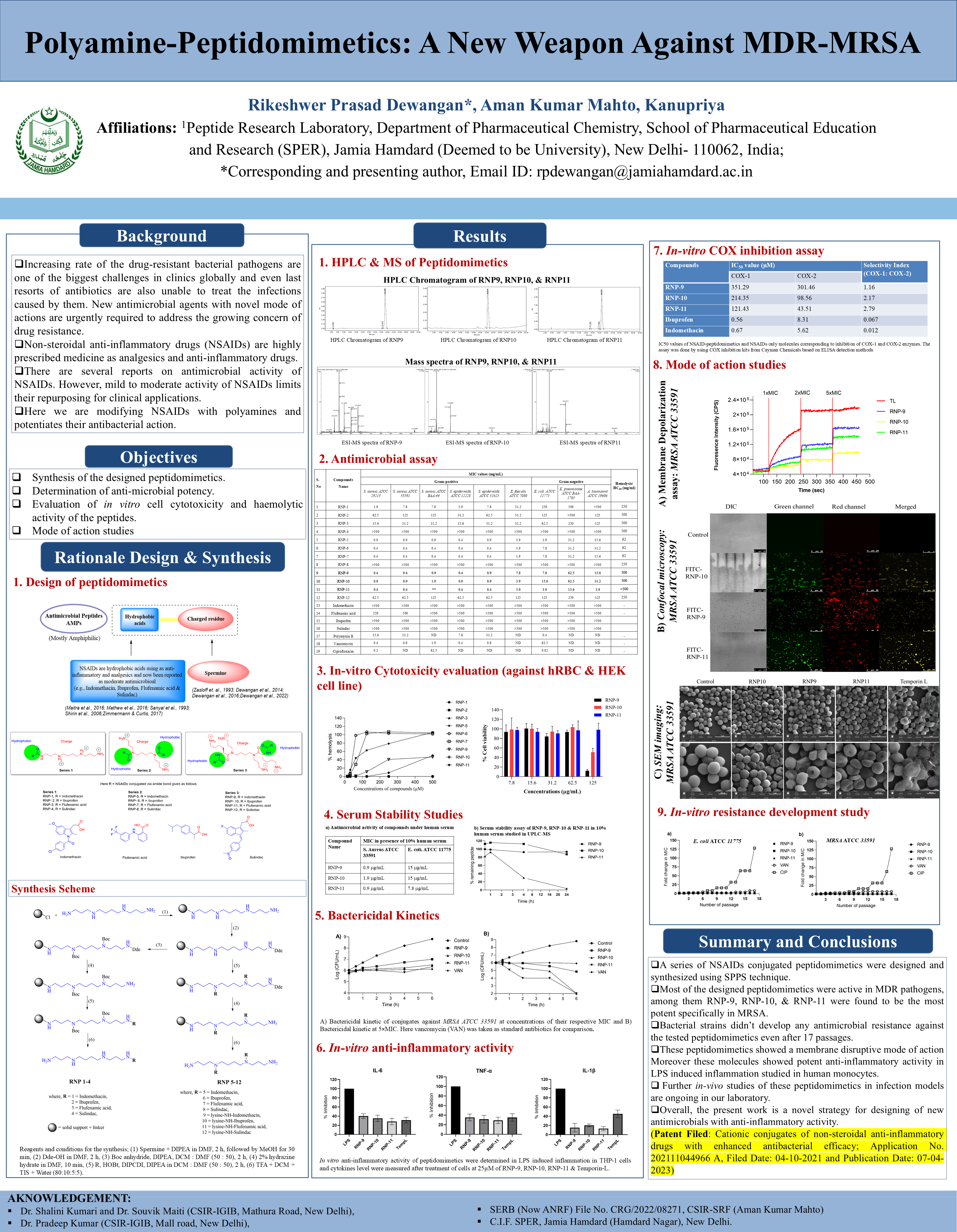
Antimicrobial Resistance (AMR), highlighted by the emergence of multidrug-resistant S. aureus (MDR-MRSA), is a severe and urgent global public health threat. This resistance mechanism renders common medications ineffective, making bacterial infections exceedingly difficult or impossible to cure. Consequently, this crisis leads to treatment failures, prolonged illness, severe complications, and increased mortality rates worldwide, underscoring the critical need for novel therapeutic solutions. This study addresses the crisis by developing a new class of polyamine (spermine) conjugated peptidomimetics, exploiting S. aureus’s natural deficiency in polyamine biosynthesis and resulting hypersensitivity to external polyamines.
Methods
Based on minimal pharmacophore model of antimicrobial peptidomimetics, we have conjugated spermine and non-steroidal anti-inflammatory drugs (NSAIDs) by solid phase synthesis methods. All the synthesized molecules were evaluated for antibacterial activity against gram-positive and gram-negative pathogenic bacteria including MDR pathogens. Further mode of action of most active compound was evaluated by bacterial membrane depolarization assay and microscopic studies (SEM and TEM). Being a conjugate of NSAIDs these conjugated were also evaluated for cyclooxygenase inhibition activity and cytokine inhibition assay in cellular models. Finally, the in-vivo antibacterial efficacy was assessed in bacterial infection model in mice.
Results
Within library of synthesized compounds, RNP-11 was demonstrated robust, equipotent antibacterial activity against severe clinical isolates, including MDR-MRSA, VRSA, and VRE. Their mode of action was concentration-dependent: low concentrations (1×MIC) are bacteriostatic, while high concentrations (5×MIC) were bactericidal. Biophysical and microscopic evidence confirmed that the primary mechanism involves concentration-dependent damage to the bacterial cell membrane. Furthermore, some lead molecules also showed anti-inflammatory activity in LPS induced inflammation. A vital finding was the low resistance potential: the peptidomimetics did not induce mutant selection in S. aureus even after 35 passages. Finally, in a mouse infection model, treated animals showed a significant reduction in bacterial load, validating their promise.
Conclusions
The above findings demonstrated that polyamine conjugated peptidomimetics are potential therapeutics against MRSA related infections and further can be optimized for development of new class of antibacterial agents against raising antimicrobial resistance.
Leave A Comment