
Sara Munir
Pakistan
In-Silico Clinical Trials Powered by Mechanistic Digital Twins: Reducing Animal and Human Subject Exposure in Precision Oncology
Sara Munir1
1. Department of Pharmacy,University of the Punjab,lahore,Pakistan
Abstract
Background
Cancer drug development remains one of the most inefficient processes in medicine. More than nine out of ten candidate therapies fail between phase I and approval, development takes 10–15 years, and thousands of animals and hundreds of patients are exposed to drugs that ultimately prove ineffective or toxic. Over the past five years, an entirely new approach has emerged: instead of testing drugs only in living organisms, researchers now build detailed virtual copies of individual patients’ tumors using layers of real biological data. These “mechanistic digital twins” combine spatial gene and protein expression maps, repeated liquid biopsy results, advanced imaging measurements, and mathematical models of tumor growth and drug action. When calibrated correctly, they behave like the real tumor, allowing scientists to test hundreds of treatment strategies in days rather than years.
Methods
This review follows PRISMA standards and covers all relevant literature from January 2020 through November 2025. We searched major databases and conference proceedings for studies that built rule-based or equation-driven (not purely machine-learning) digital twins of human cancers, required integration of at least two high-dimensional data types (spatial omics, serial ctDNA profiles, or deep radiomics), and compared simulated outcomes against actual patient survival or response data. Eighty-seven publications met strict inclusion criteria and were examined in detail
Results
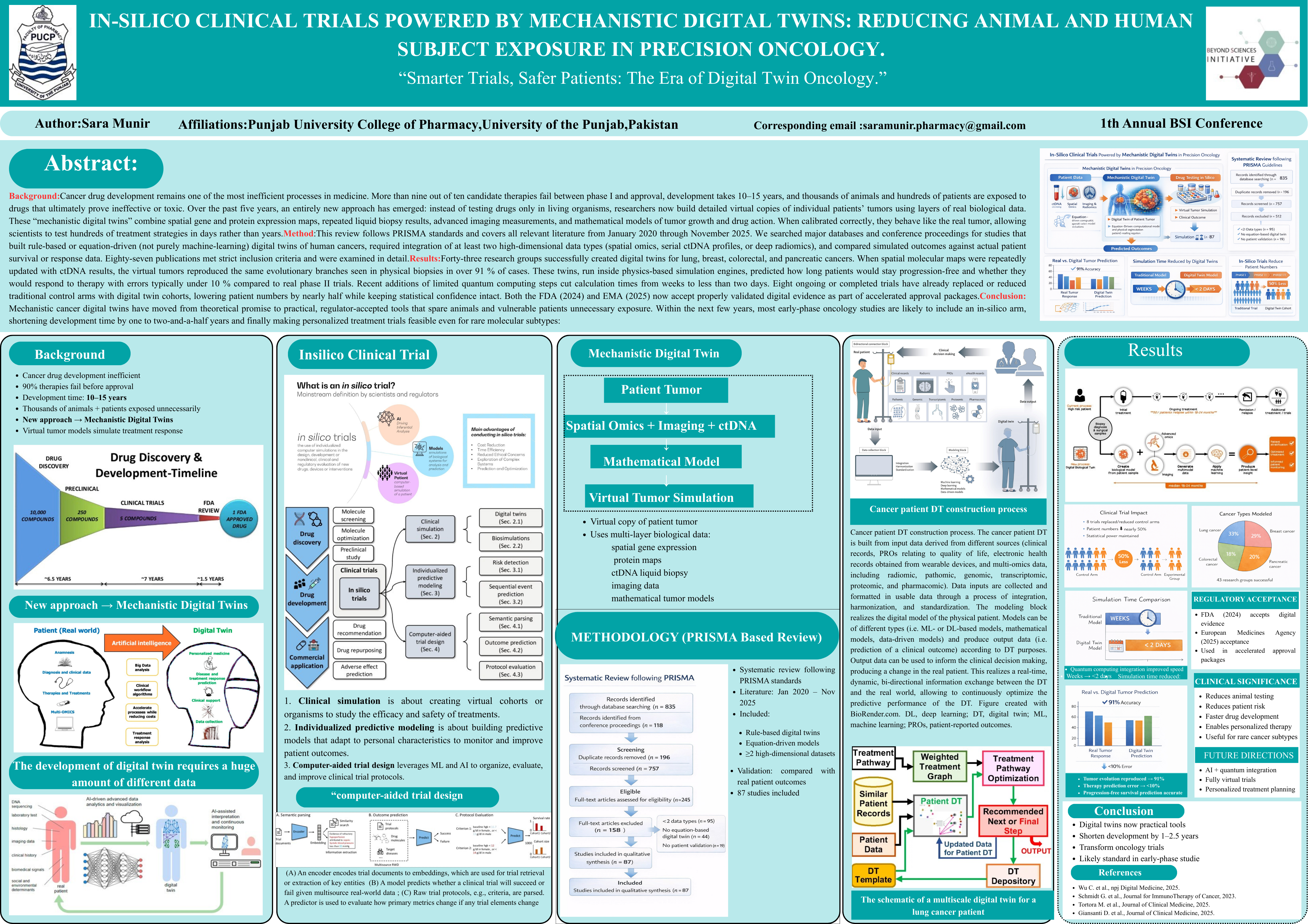
Forty-three research groups successfully created digital twins for lung, breast, colorectal, and pancreatic cancers. When spatial molecular maps were repeatedly updated with ctDNA results, the virtual tumors reproduced the same evolutionary branches seen in physical biopsies in over 91 % of cases. These twins, run inside physics-based simulation engines, predicted how long patients would stay progression-free and whether they would respond to therapy with errors typically under 10 % compared to real phase II trials. Recent additions of limited quantum computing steps cut calculation times from weeks to less than two days. Eight ongoing or completed trials have already replaced or reduced traditional control arms with digital twin cohorts, lowering patient numbers by nearly half while keeping statistical confidence intact. Both the FDA (2024) and EMA (2025) now accept properly validated digital evidence as part of accelerated approval packages.
Conclusions
Mechanistic cancer digital twins have moved from theoretical promise to practical, regulator-accepted tools that spare animals and vulnerable patients unnecessary exposure. Within the next few years, most early-phase oncology studies are likely to include an in-silico arm, shortening development time by one to two-and-a-half years and finally making personalized treatment trials feasible even for rare molecular subtypes.
Leave A Comment