
Amulya Etikala
India
Targeted Brain Delivery of Berberine Nanoemulsion: Preclinical Insights and Cognitive Rescue in Scopolamine-Induced Alzheimer’s Model
Etikala Amulya*1, Mansi Negi1, Vivek Phatale1, Saurabh Srivastava1
1. Department of Pharmaceutics, National Institute of Pharmaceutical Education and Research (NIPER), Hyderabad, Telangana, India
Abstract
Background
Alzheimer’s disease (AD) is a progressive neurodegenerative disorder predominantly affecting the elderly. According to the Alzheimer’s Association report (2023), approximately 6.7 million Americans aged ≥65 years are living with AD, and WHO projections estimate global cases may surpass 100 million by 2050, highlighting the urgent need for effective therapeutic interventions.
Methods
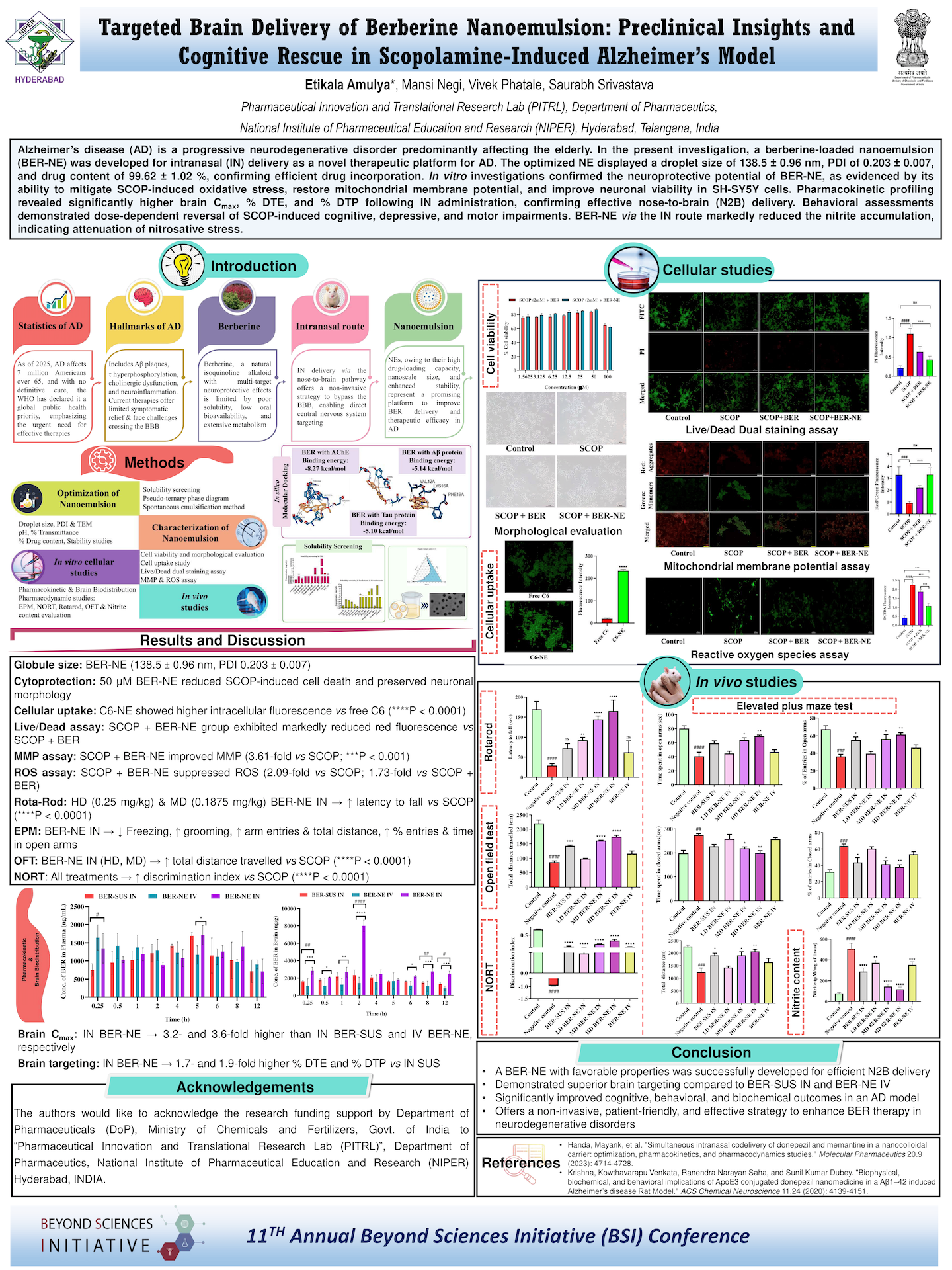
In the present investigation, a berberine-loaded nanoemulsion (BER-NE) was developed for intranasal (IN) delivery as a novel therapeutic platform for AD. The formulation was characterized for droplet size, polydispersity index (PDI), morphological features, and drug content. In vitro assays were conducted on SH-SY5Y neuroblastoma cells to evaluate cytoprotective effects, while in vivo studies were performed in Wistar rats to assess brain targeting efficiency and therapeutic efficacy.
Results
The optimized NE displayed a droplet size of 138.5 ± 0.96 nm, PDI of 0.203 ± 0.007, and drug content of 99.62 ± 1.02 %. In vitro studies on SH-SY5Y cells demonstrated that BER-NE reduced reactive oxygen species levels by 2.09-fold and restored mitochondrial membrane potential, reflected by a 3.61-fold increase in red/green fluorescence intensity compared to scopolamine (SCOP)-treated cells. Pharmacokinetic profiling revealed that IN BER-NE achieved a 3.2- and 3.6-fold increase in brain Cmax compared to IN BER-suspension and BER-NE IV, respectively. The IN BER-NE depicted a 1.7- and 1.9-fold increase in % DTE and % DTP compared to the IN BER-suspension, which supports the efficient nose-to-brain delivery. Behavioural assessments demonstrated dose-dependent reversal of SCOP-induced cognitive, depressive, and motor impairments. BER-NE via the IN route markedly reduced the nitrite accumulation by 4.3-fold relative to the SCOP group, indicating attenuation of nitrosative stress.
Conclusions
Collectively, these findings underscore the potential of BER-NE as a promising, non-invasive, and patient-friendly therapeutic strategy for AD management.
Leave A Comment