
Anna Gabriele dos Santos
Brazil
Expression profile of the hTERT gene and relative telomere length in bladder tumor cell lines
Anna Gabriele Prado dos Santos1, Celina Yung-Ai Lin Lee1, Isabely Mayara da Silva1, Andresa Hiromi Sakai1, Flávia Eliza Staut Silva1, Arthur Mikalixen1, Giedre Vigo Duarte de Freitas1, Juliana Mara Serpeloni1
1. Department of General Biology, State University of Londrina, Londrina – PR, Brazil.
Abstract
Background
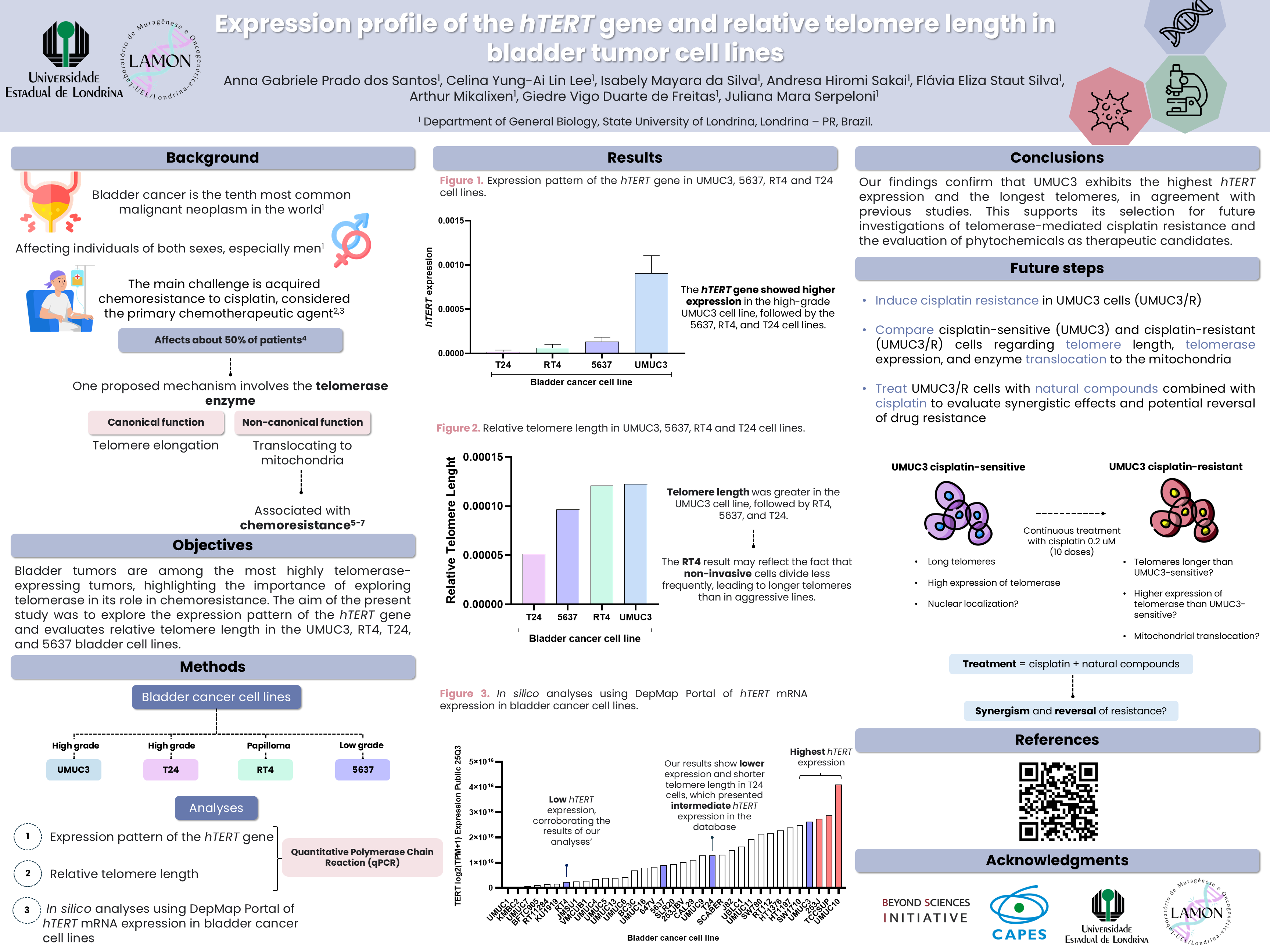
BACKGROUND: Bladder cancer is the tenth most common malignant neoplasm in the world, affecting individuals of both sexes, especially men. Among the main challenges in treatment, the resistance that tumors acquire to cisplatin, considered the primary chemotherapeutic agent, stands out. This resistance affects about 50% of patients, and one proposed mechanism involves the telomerase enzyme. In addition to telomere elongation induced by telomerase, telomerase can also exert non-canonical functions by translocating to mitochondria, triggering cellular responses associated with chemoresistance. It is also known that bladder tumors are among the most highly telomerase-expressing tumors, highlighting the importance of exploring telomerase in its role in chemoresistance.
Methods
METHODS: The present study explores the expression pattern of the hTERT gene and evaluates relative telomere length in the UMUC3, RT4, T24, and 5637 bladder cell lines. Both techniques were assessed using quantitative Polymerase Chain Reaction (qPCR). In silico analyses of hTERT mRNA expression in bladder cancer cell lines were performed using DepMap Portal data, and the cells were ranked by expression intensity.
Results
RESULTS: The hTERT gene showed higher expression in the high-grade UMUC3 cell line, followed by the 5637, RT4, and T24 cell lines. Telomere length was also greater in the UMUC3 cell line, followed by RT4, 5637, and T24. The DepMap database provided data for 35 bladder tumor cell lines, with UMUC10, TCCSUP, 253J, and UMUC3 showing the highest hTERT expression. Considering the cells evaluated in this study, UMUC3 showed the highest hTERT expression. On the other hand, our results show lower expression and shorter telomere length in T24 cells, which presented intermediate hTERT expression in the database. Regarding the papilloma-derived RT4 cell line, it showed low hTERT expression, corroborating the results of the in silico analyses. However, it exhibited one of the greatest telomere lengths; this result may reflect the fact that non-invasive cells, such as RT4, divide less frequently, leading to longer telomeres than in aggressive lines.
Conclusions
CONCLUSIONS: Our findings confirm that UMUC3 exhibits the highest hTERT expression and the longest telomeres, in agreement with previous studies. This supports its selection for future investigations of telomerase-mediated cisplatin resistance and the evaluation of phytochemicals as therapeutic candidates.
Leave A Comment