
Mahfoudi Hajar
Morocco
Contribution of Occupational Exposures to COPD Incidence in Morocco: Estimation of the Attributable Fraction and preventable cases
H. Mahfoudi¹²³, N. Bahra¹²³, F. bartal¹²³, I. El Harch¹²³, S. Benmaamar¹²³, M. Maiouak¹²³, N. Tachfouti¹²³, K. El Rhazi¹²³
¹ Department of Epidemiology, Clinical Research, and Community Health, Faculty of Medicine, Pharmacy and Dentistry, Fez, Morocco
² Laboratory of Epidemiology and Health Sciences Research, Sidi Mohamed Ben Abdellah University, Fez, Morocco
³ Hassan II University Hospital Center, Fez, Morocco
Abstract
Background
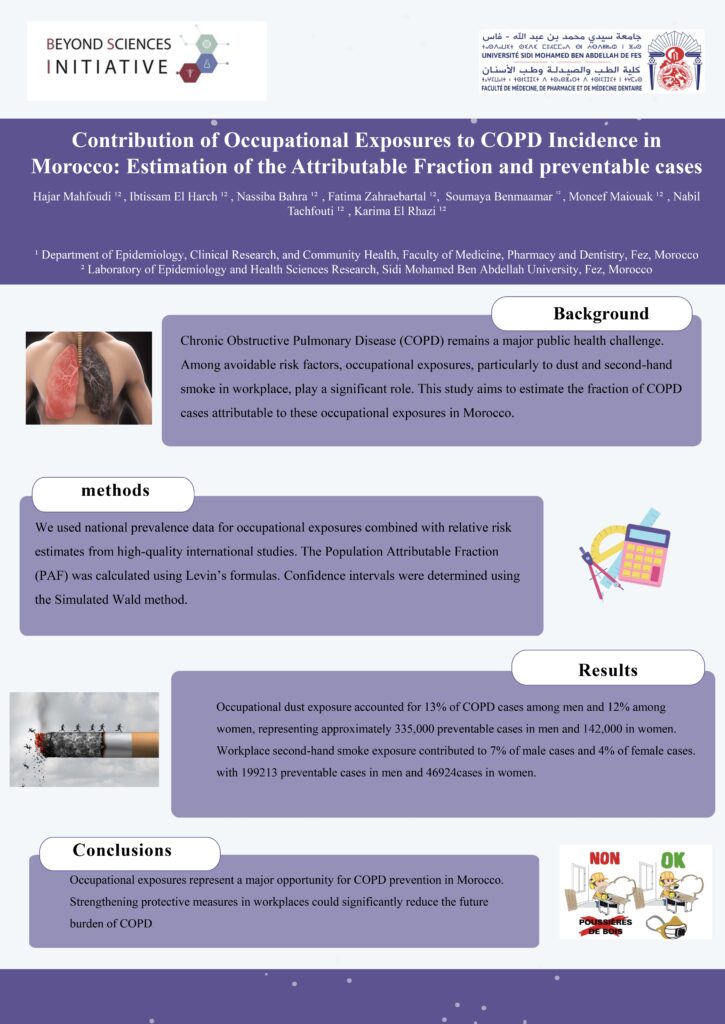
Chronic Obstructive Pulmonary Disease (COPD) remains a major public health challenge. Among avoidable risk factors, occupational exposures, particularly to dust and second-hand smoke in the workplace, play a significant role.
This study aims to estimate the fraction of COPD cases attributable to these occupational exposures in Morocco.
Methods
We used national prevalence data for occupational exposures combined with relative risk estimates from high-quality international studies. The Population Attributable Fraction (PAF) was calculated using Levin’s and SAMMEC formulas. Confidence intervals were determined using the Simulated Wald method.
Results
Occupational dust exposure accounted for 13% of COPD cases among men and 12% among women, representing approximately 335,000 preventable cases in men and 142,000 in women. Workplace second-hand smoke exposure contributed to 7% of male cases and 4% of female cases. with 199213 preventable cases in men and 46924cases in women.
Conclusions
Occupational exposures represent a major opportunity for COPD prevention in Morocco. Strengthening protective measures in workplaces could significantly reduce the future burden of COPD.
Leave A Comment