
Ursula-Claire Andong-Koung-Edzidzi
South Africa
AuristatinF delivering SNAP-tag recombinant antibody-drug conjugate targeting EpCAM for the selective killing of triple-negative breast cancer cells.
Ursula-Claire Andong-Koung-Edzidzi 1, Thabo Matshoba1, Dirk Lang 2, Roger Hunter 3 and Stefan Barth 1,4
1. Medical Biotechnology and Immunotherapy Research Unit, Department of Integrative Biomedical Sciences, Institute of Infectious Disease and Molecular Medicine, Faculty of Health Sciences, University of Cape Town, Cape Town 7700, South Africa
2. Division of Physiological Sciences, Department of Human Biology, University of Cape Town, Cape Town 7700, South Africa
3. Department of Chemistry, PD Hahn Building, University of Cape Town, Cape Town 7700, South Africa
4. South African Research Chair in Cancer Biotechnology, Department of Integrative Biomedical Sciences, Faculty of Health Sciences, University of Cape Town, Cape Town 7700, South Africa
Abstract
Background
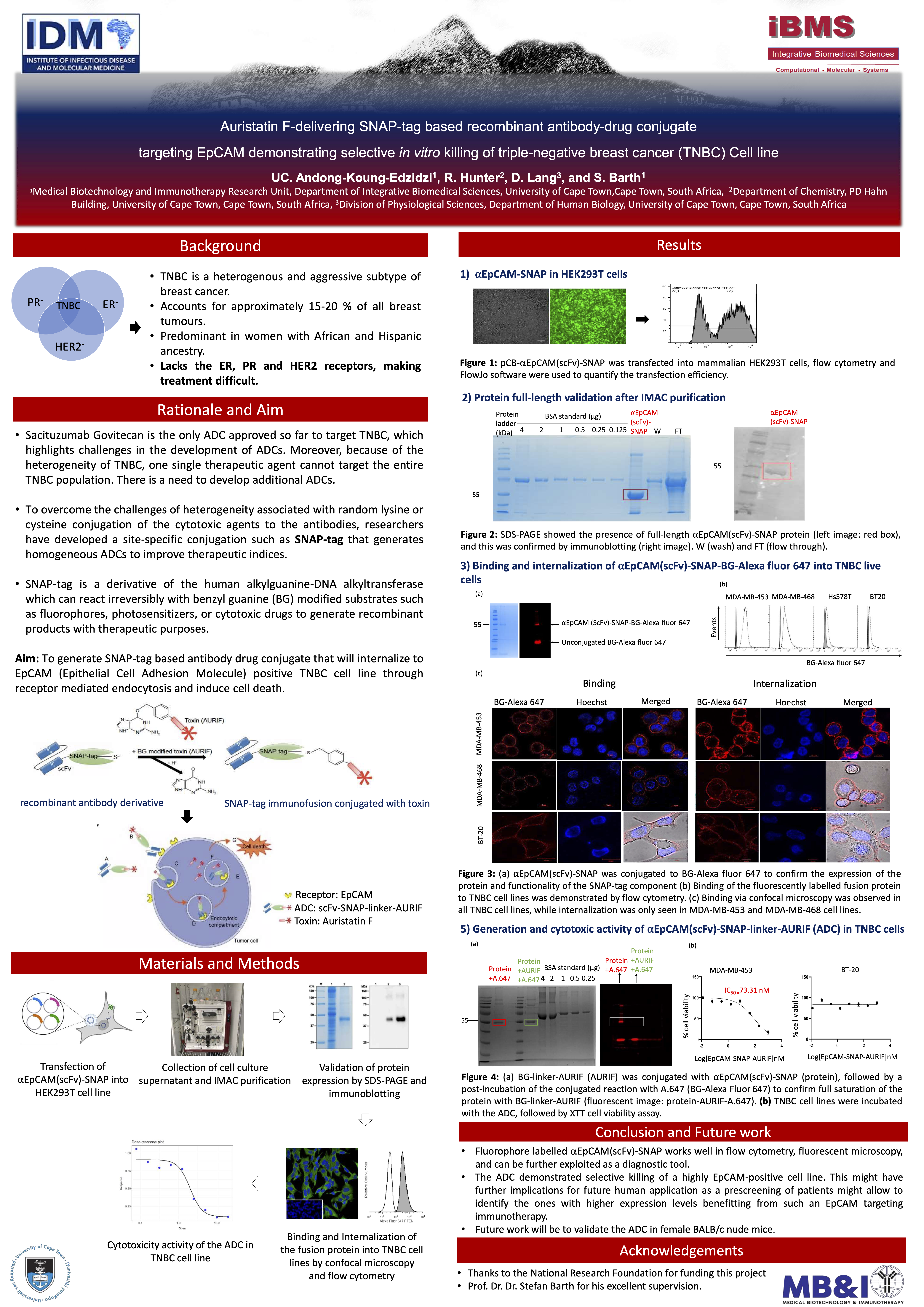
Triple-negative breast cancers (TNBCs) are regarded as heterogenous, and aggressive types of breast cancer majoritarily affecting women of African ancestry. They are the product of impaired expression of the ER, PR, and HER2 receptor. According to the American society of clinical oncology of American pathologists’ guidelines, TNBCs typically expressed < 1% oestrogen and progesterone receptors and, between 0-1% HER2 receptor. Hence, treatment is difficult and has been described as fatal. Consequently, gene expression studies have identified several potential upregulated pathways which are differentially expressed in the different subtypes and therefore corresponding receptors (such as EpCAM) overexpressed in these pathways are being considered as high potential diagnostic/therapeutic targets. The aims of this thesis is to conjugate antiEpCAM(scFv)-SNAP to a small molecule compound to generate a next generation recombinant ADC that will internalize into antigen positive TNBC cells through receptor mediated endocytosis and induce cell death
Methods
In-silico design of expression vectors was used to prepare for the implementation of standard molecular cloning techniques to clone the respective genes of interest into established plasmids for transient mammalian expression. Secreted fusion proteins were isolated from cell culture supernatants (CCSN) by immobilized metal affinity chromatography (IMAC). Full-length protein was confirmed by SDS-PAGE and Western blot, before analysing for binding and internalization to/into EpCAM-positive cell lines using fluorophore conjugated constructs. Subsequently, a modified auristatin F (AURIF) anticancer drug was conjugated to assess dose-dependent biological activities of the therapeutic protein on the TNBC cell lines with proven binding.
Results
Plasmid for expression of an anti-EpCAM single chain fragment of variability (scFv) genetically fused to the SNAP-tag (αEpCAM(scFv)-SNAP) were successfully cloned. Full length recombinant protein purified from cell culture supernatant was conjugated to Benzylguanine (BG)-modified Alexa fluor 647 and binding as well as internalization were to EpCAM positive TNBC cell lines confirmed by flow cytometry and confocal microscopy. Surface binding was observed across all cell lines, however internalization was observed on two TNBC lines. ⍺EpCAM(scFv)-SNAP labelled with BG-modified AURIF demonstrated dose-dependent killing of the antigen positive TNBC cell line. No killing was observed on the antigen-negative cell line.
Conclusions
Fluorophore labelled EpCAM(scFv)-SNAP works well in flow cytometry and fluorescent microscopy and can be further exploited as a diagnostic tool. The recombinant antibody-drug-conjugate (EpCAM(scFv)-SNAP-AURIF) demonstrated selective killing of highly EpCAM-positive cell lines. This might have further implications for future human application as a prescreening of patients might allow to identify the ones with higher expression levels benefitting from such an EpCAM targeting immunotherapy.
Leave A Comment