
Nermin M. Mohamed
Egypt
Uncovering the Multifaceted Role of the Kinetochore Scaffold 1 in Hepatocellular Carcinoma: In-Silico Analysis and CRISPR-Cas9 Experimental Study
Nermin M. Mohamed1, Rania Hassan Mohamed2, Mahmoud M. Elhefnawi3, Nadia M. Hamdy1
1 Biochemistry Department, Faculty of Pharmacy, Ain Shams University, Abassia 11566, Cairo, Egypt,
2 Biochemistry Department, Faculty of Science, Ain Shams University, Abassia 11566, Cairo, Egypt,
3 Biomedical Informatics and Chemoinformatics Group, Informatics and Systems Department, National Research Centre, Dokki 12622, Cairo, Egypt
Abstract
Background
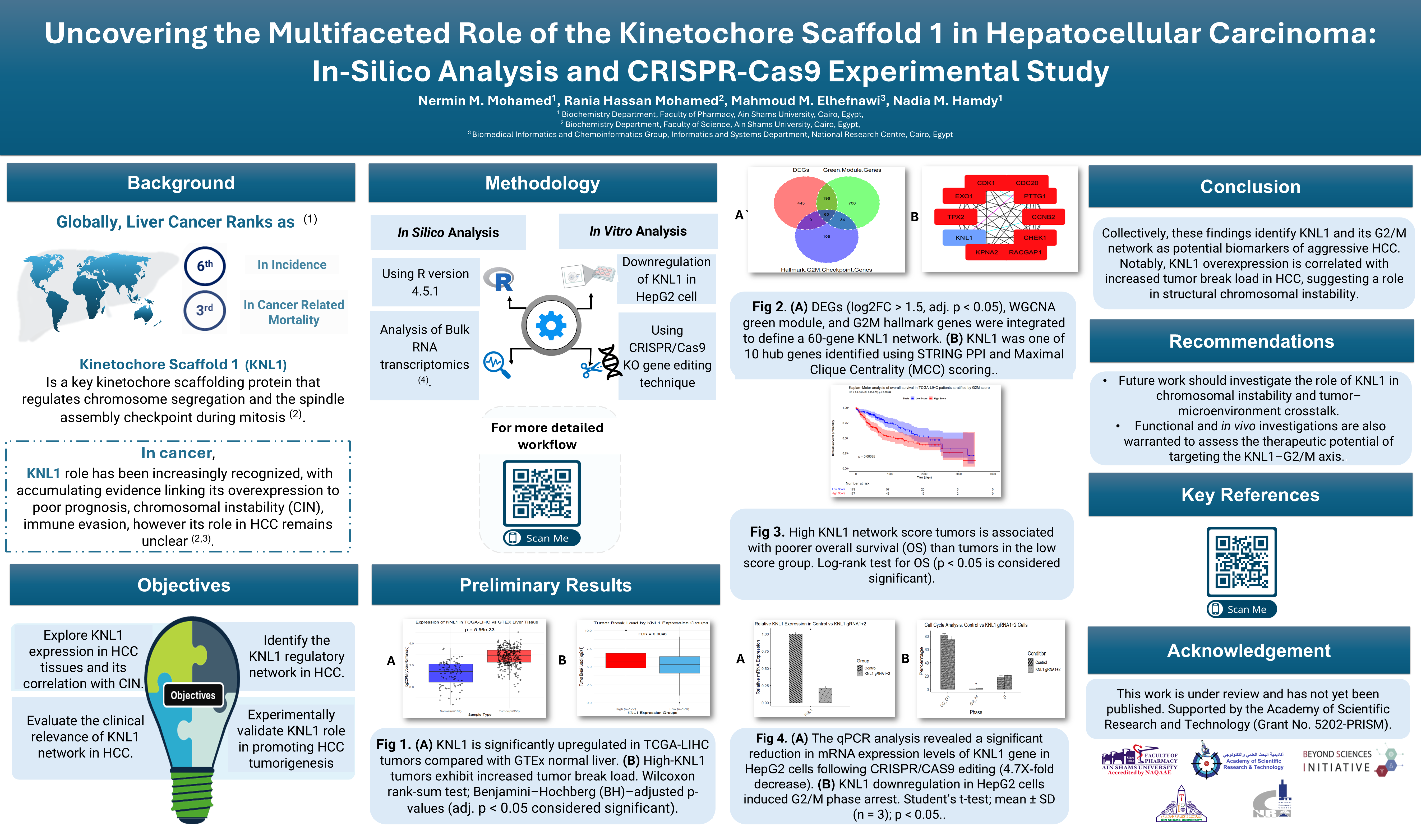
Hepatocellular carcinoma (HCC) is a leading cause of cancer mortality, driven by late diagnosis, tumor heterogeneity, and resistance to systemic therapies. Chromosomal instability (CIN), a hallmark of HCC, fuels tumor evolution and poor outcomes. Kinetochore scaffold 1 (KNL1), a core spindle assembly checkpoint (SAC) protein, ensures accurate chromosome segregation but is increasingly recognized for its oncogenic potential. KNL1 is overexpressed in several cancers, where it promotes CIN, proliferation, and immune evasion. However, its molecular network and functional role in HCC remain unclear, representing a critical knowledge gap.
Methods
We integrated bulk RNA-seq data (TCGA-LIHC, GTEx) and single-cell RNA-seq data (GSE149614) to characterize KNL1-associated oncogenic pathways. Weighted gene co-expression network analysis (WGCNA), MSigDB hallmark enrichment, and protein–protein interaction mapping defined a KNL1 network, which was quantified using single-sample GSEA (ssGSEA) to stratify tumors. Correlations with prognosis, immune landscape (CIBERSORTx, TIDE), CIN, and MKI67 expression were evaluated. Single-cell analysis examined KNL1 network activity across cell types, while CellChat identified tumor–stromal–immune signalling pathways. Functional validation was performed using CRISPR-Cas9 knockdown of KNL1 in HepG2 cells, followed by proliferation, cell cycle, and ultrastructural studies.
Results
KNL1 was markedly overexpressed in HCC, especially in TP53-mutant tumors, and correlated with tumor break load. WGCNA identified a G2M checkpoint module with KNL1 among the top hub genes. A derived KNL1-G2M score stratified patients into prognostic groups: high scores predicted poor survival, elevated CIN, and proliferation. High-score tumors showed enrichment of T-regulatory cells, M0 macrophages, and immune exclusion, indicating checkpoint blockade resistance. Single-cell analysis confirmed module activation in malignant hepatocytes, while CellChat revealed integrin-, syndecan-, and MHC-I–mediated signalling linked to extracellular matrix remodelling and immune evasion. KNL1 knockdown induced G2/M arrest, suppressed PI3K/AKT signalling, reduced proliferation, and triggered early apoptosis-like changes.
Conclusions
Beyond its canonical spindle assembly checkpoint role, the KNL1–G2M axis emerges as a key driver of oncogenic signaling, immune evasion, and extracellular matrix remodeling, underscoring its potential as a therapeutic target in HCC.
Leave A Comment