
María Moya Navamuel
Panama
Natural products as enhancers of tumor antigen presentation and immune sensitivity in colorectal cancer models
María Moya-Navamuel1,3, Olga Genilloud2 and Timothy M Thomson1,4
1. Instituto de Investigaciones Científicas y Servicios de Alta Tecnología (INDICASAT-AIP), Panama City, Panama
2. Fundación MEDINA, Granada, Spain
3. Doctoral Program, Department of Biotechnology, Universitat Politècnica de València (UPV), Valencia, Spain
4. Plataforma Temática Interdisciplinar Salud Global (PTI-SG), Consejo Superior de Investigaciones Científicas, Madrid, Spain
Abstract
Background
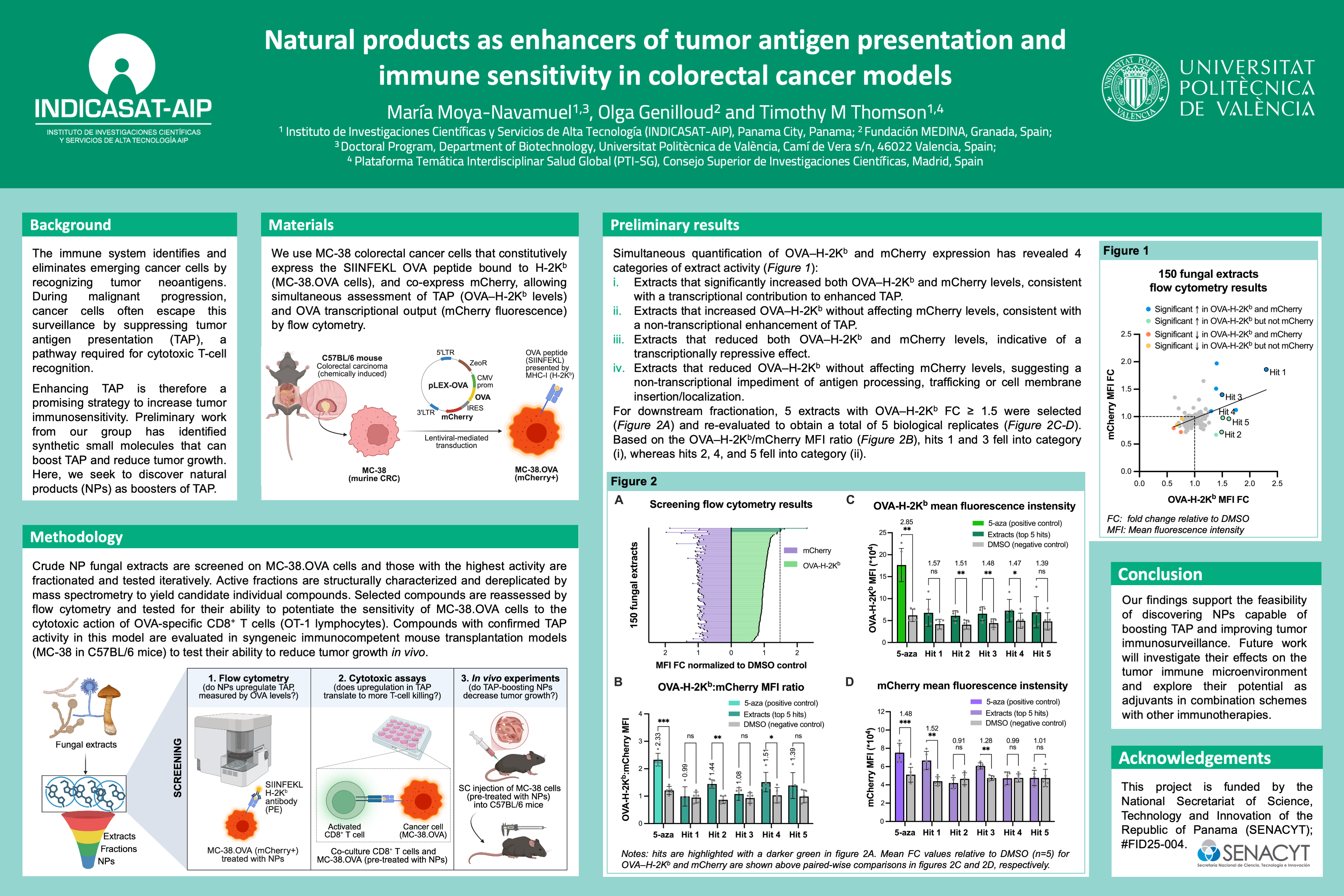
The immune system identifies and eliminates emerging cancer cells by recognizing tumor neoantigens. During malignant progression, cancer cells often escape this surveillance by suppressing tumor antigen presentation (TAP), a pathway required for cytotoxic T-cell recognition. Enhancing TAP is therefore a promising strategy to increase tumor immunosensitivity. Preliminary work from our group has identified synthetic small molecules that can boost TAP and reduce tumor growth. Here, we seek to discover natural products (NPs) as boosters of TAP.
Methods
We use MC38 colorectal cancer cells that constitutively express the SIINFEKL OVA peptide bound to H-2Kb (MC38.OVA cells), and co-express mCherry, allowing simultaneous assessment of TAP (OVA–H-2Kb levels) and OVA transcriptional output (mCherry fluorescence) by flow cytometry. Crude NP extracts are screened on MC38.OVA cells and those with the highest activity are fractionated and tested iteratively. Active fractions are structurally characterized and dereplicated by mass spectrometry to yield candidate individual compounds. Selected compounds are reassessed by flow cytometry and tested for their ability to potentiate the sensitivity of MC38.OVA cells to the cytotoxic action of OVA-specific CD8+ T cells (OT-1 lymphocytes). Compounds with confirmed TAP activity in this model are evaluated in syngeneic immunocompetent mouse transplantation models (MC38 in C57BL/6 mice) to test their ability to reduce tumor growth in vivo.
Results
Simultaneous quantification of OVA–H-2Kb and mCherry expression has yielded 4 categories of activity among the extracts: (1) Extracts that significantly enhance both OVA–H-2Kb and mCherry levels, suggestive of a transcriptional contribution to the enhanced expression of OVA–H-2Kb; (2) Extracts that enhance OVA–H-2Kb but not mCherry levels, suggestive of a non-transcriptional TAP-boosting effect; (3) Extracts that reduce both OVA–H-2Kb and mCherry levels, suggestive of a transcriptional repressive effect; and (4) extracts that reduce OVA–H-2Kb but not mCherry levels, suggestive of a non-transcriptional impediment of antigen processing, trafficking or cell membrane insertion/localization.
Conclusions
Our findings support the feasibility of discovering NPs capable of boosting TAP and improving tumor immunosurveillance. Future work will investigate their effects on the tumor immune microenvironment and explore their potential as adjuvants in combination schemes with other immunotherapies.
Leave A Comment