
Oleksandr Mushii
Ukraine
MicroRNA-Based Multiple Logistic Regression Models for Predicting Molecular Subtypes of Breast Cancer
R.E. Kavetsky Institute of Experimental Pathology, Oncology and Radiobiology, National Academy of Sciences of Ukraine, 45 Vasylkivska St., 03022, Kyiv, Ukraine
Abstract
Background
Molecular classification of breast cancer (BC) is a key element of personalized treatment, as the molecular subtype determines tumor biology, sensitivity to endocrine, targeted, and chemotherapy, and overall prognosis. Accurate differentiation of subtypes (Luminal A, Luminal B, HER2-positive, Triple-negative) enables rational therapeutic strategies and risk assessment of disease progression. Therefore, there is a need to identify molecular markers, including microRNAs, that can serve as predictors of tumor subtype.
Methods
For preliminary bioinformatic selection of microRNAs associated with the tumor microenvironment of BC, public transcriptomic datasets from GEO (NCBI) were analyzed to identify differentially expressed and functionally relevant candidate microRNAs. Expression levels of selected microRNAs in BC tissue were measured using quantitative reverse-transcription PCR (qRT-PCR) normalized to reference RNAs. Multiple logistic regression was applied to integrate the expression data into predictive models for molecular subtype, with microRNA levels as predictors and classification into four main molecular subtypes as the dependent variable. Model discrimination was evaluated using ROC curves with the calculation of AUC, sensitivity, and specificity.
Results
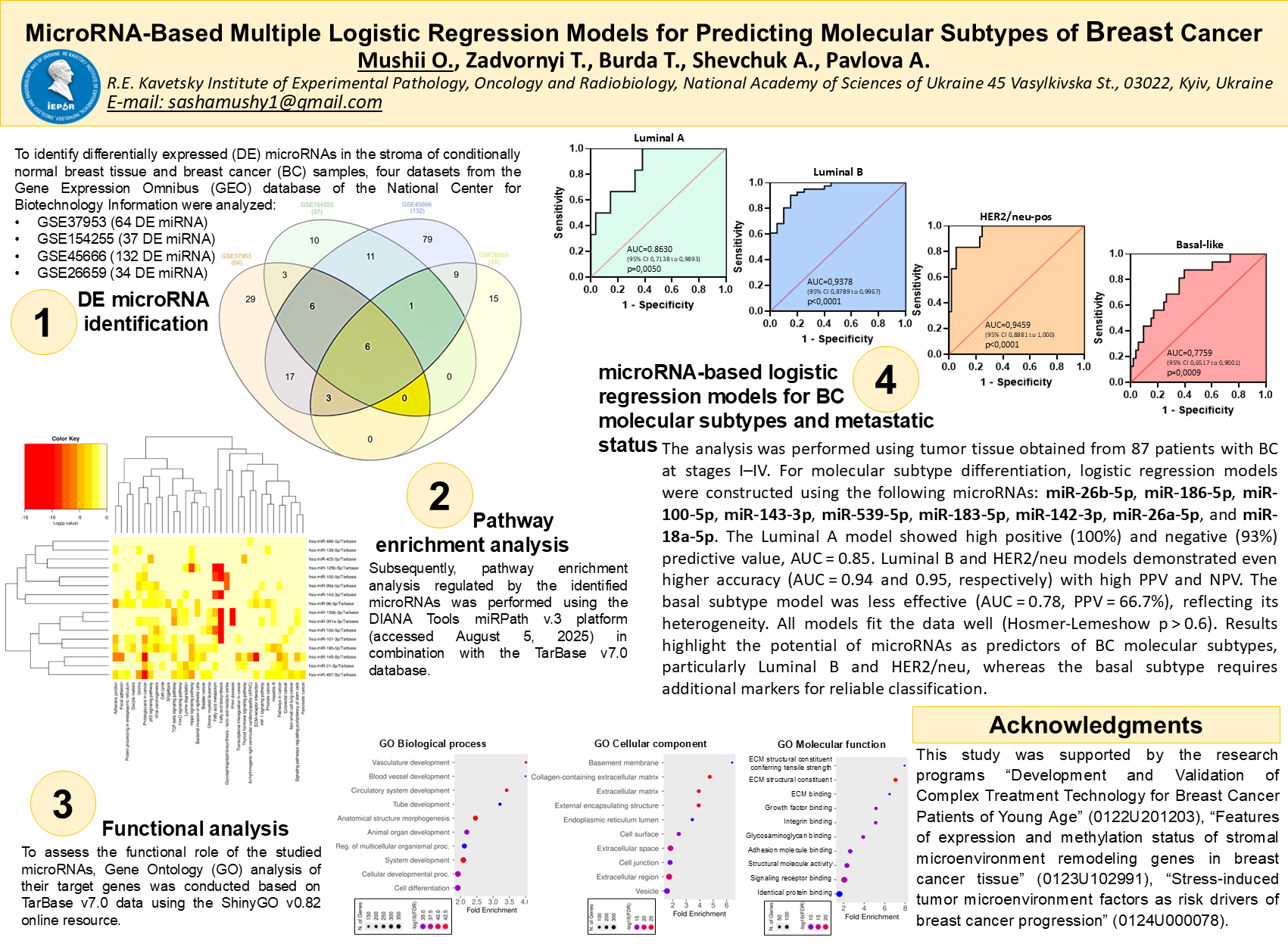
Multiple logistic regression models based on microRNA expression predicted BC molecular subtypes. The Luminal A model showed high positive (100%) and negative (93%) predictive value, AUC = 0.85. Luminal B and HER2/neu models demonstrated even higher accuracy (AUC = 0.94 and 0.95, respectively) with high PPV and NPV. The basal subtype model was less effective (AUC = 0.78, PPV = 66.7%), reflecting its heterogeneity. All models fit the data well (Hosmer-Lemeshow p > 0.6). Results highlight the potential of microRNAs as predictors of BC molecular subtype, particularly strong for Luminal B and HER2/neu, while the basal subtype requires additional markers for reliable classification.
Conclusions
Multiple logistic regression based on microRNA expression reliably predicts BC molecular subtypes. Models for Luminal A and B, and HER2/neu demonstrated high accuracy (AUC 0.85–0.95) with strong predictive value, confirming clinical relevance. The basal subtype model showed lower effectiveness (AUC = 0.78), reflecting heterogeneity. All models were consistent with the data (Hosmer-Lemeshow p > 0.6). The findings underscore the potential of microRNAs as predictors for personalized prognosis and therapeutic strategies.
Funding: This study was supported by the Research Program ‘Development and validation of complex treatment technology for breast cancer patients of young age’ (No. 0122U201203) financed by the Ministry of Education and Science of Ukraine, and Research Programs ‘Stress-induced tumor microenvironment factors as risk drivers of breast cancer progression’ (No. 0124U000078) funded by the National Academy of Sciences of Ukraine.
Leave A Comment