
Rozi Yeremyan
Armenia
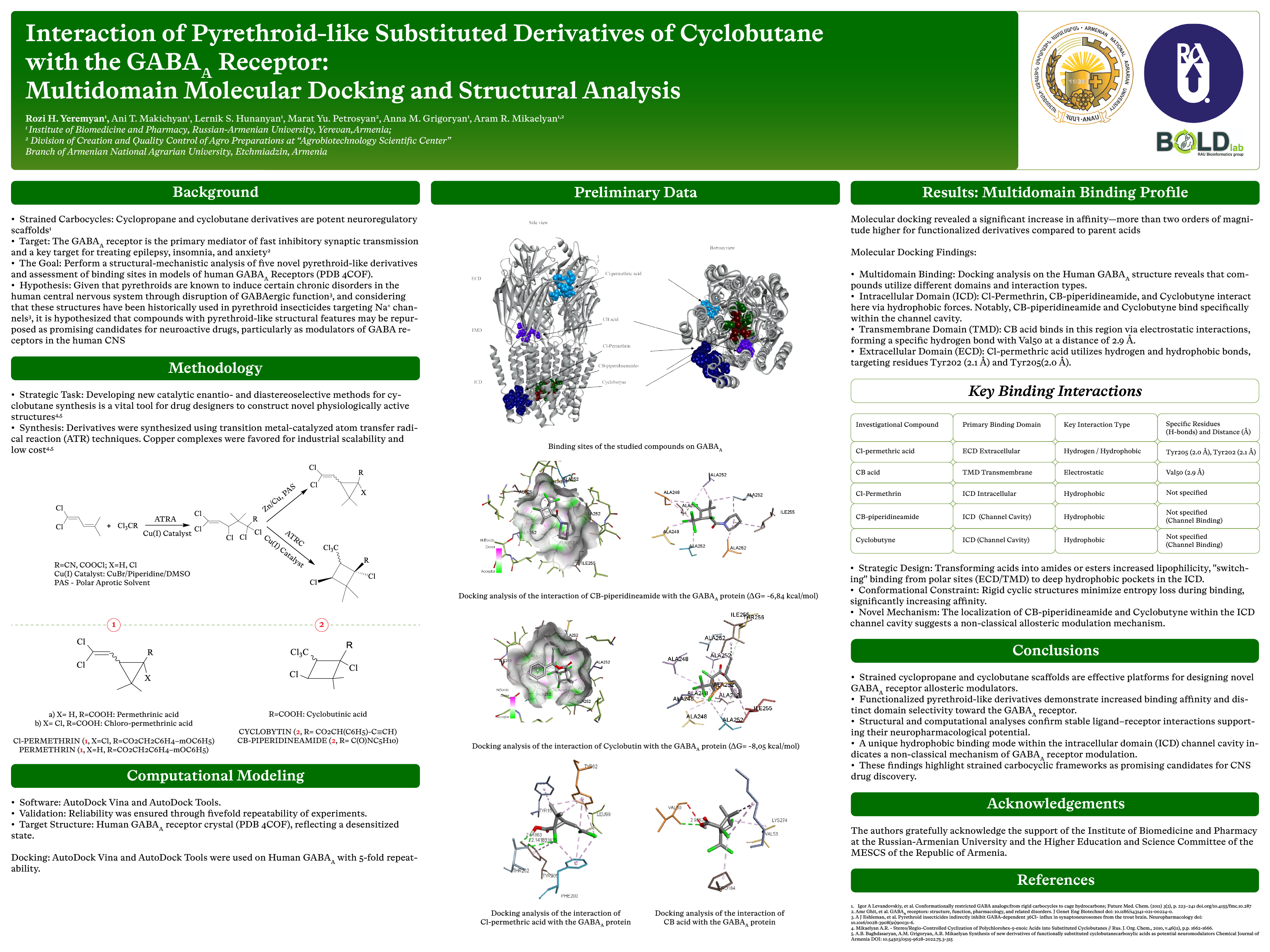
Interaction of pyrethroid-like substituted derivatives of cyclobutane with the GABAA receptor: Multidomain molecular docking and structural analysis
Rozi H. Yeremyan1, Lernik S. Hunanyan1, Anna M. Grigoryan1, Aram R. Mikaelyan1,2
1Institute of Biomedicine and Pharmacy, Russian-Armenian University, Yerevan, Armenia;
2 Division of “Creation and quality control of agro preparations” at “Agrobiotechnology Scientific Center”, Armenian National Agrarian Universit, Etchmiadzin, Armenia.
Abstract
Background
Functionally substituted cyclopropane/cyclobutane derivatives are potent neuroregulatory drugs, historically serving as scaffolds for pyrethroid insecticides that target Na+ channels. GABAA receptors are major inhibitory channels and crucial therapeutic targets. This study aimed for a structural-mechanistic analysis of newly synthesized pyrethroid-like cyclobutane derivatives and their interaction with the human GABAA receptor (PDB 4COF) using computational modeling. The derivatives were synthesized using transition metal-catalyzed ATRA/ATRC techniques, favoring copper complexes for industrial scalability.
Methods
Five novel pyrethroid-like compounds, including two acids (CB acid, Cl-permethric acid) and three functionalized derivatives (CB-piperidine amide, Cl-Permethrin, Cyclobutyne), were subjected to molecular docking experiments. The binding characteristics with the GABAA receptor (PDB 4COF) were analyzed using AutoDock Vina and AutoDock Tools packages, with the reliability of results confirmed through fivefold repeatability.
Results
Molecular docking demonstrated that the functionalized derivatives exhibited a significant increase in affinity: their binding energy was more than two orders of magnitude higher compared to the parent acids. The compounds displayed a multi-domain binding profile: Cl-permethric acid bound to the Extracellular Domain (ECD) via hydrogen bonds with Tyr205 (2.0 Å) and Tyr202 (2.1 Å); CB acid bound to the Transmembrane Domain (TMD) electrostatically, forming an H-bond with Val50 (2.9 Å); and the lipophilic derivatives (Cl-Permethrin, CB-piperidineamide, Cyclobutyne) bound exclusively to the Intracellular Domain (ICD) through hydrophobic forces. Notably, CB-piperidineamide and Cyclobutyne localized within the ICD channel cavity.
Conclusions
The strategic chemical design successfully yielded derivatives with highly increased affinity and diverse domain selectivity, validating the potential of strained carbocyclic scaffolds as a platform for novel drug candidates. The unique hydrophobic binding found in the ICD channel cavity for certain derivatives suggests a novel, non-classical mechanism for allosteric GABAA receptor modulation, opening a new direction for CNS therapeutic development.
Leave A Comment