
Nada El-Sayed
Egypt
Mangiferin mitigates methotrexate-induced liver injury and suppresses hepatic stellate cells activation: imperative role of Nrf2/NF-κB/NLRP3 axis
Nada M. El-Sayed1,2, Esther T. Menze1, Mariane G. Tadros1, Diana M.F. Hanna1
1. Department of Pharmacology and Toxicology, Faculty of Pharmacy, Ain Shams University, 11566 Cairo, Egypt.
2. School of Life and Medical Sciences, University of Hertfordshire hosted by Global Academic Foundation, New Administrative Capital, Cairo, Egypt.
Abstract
Background
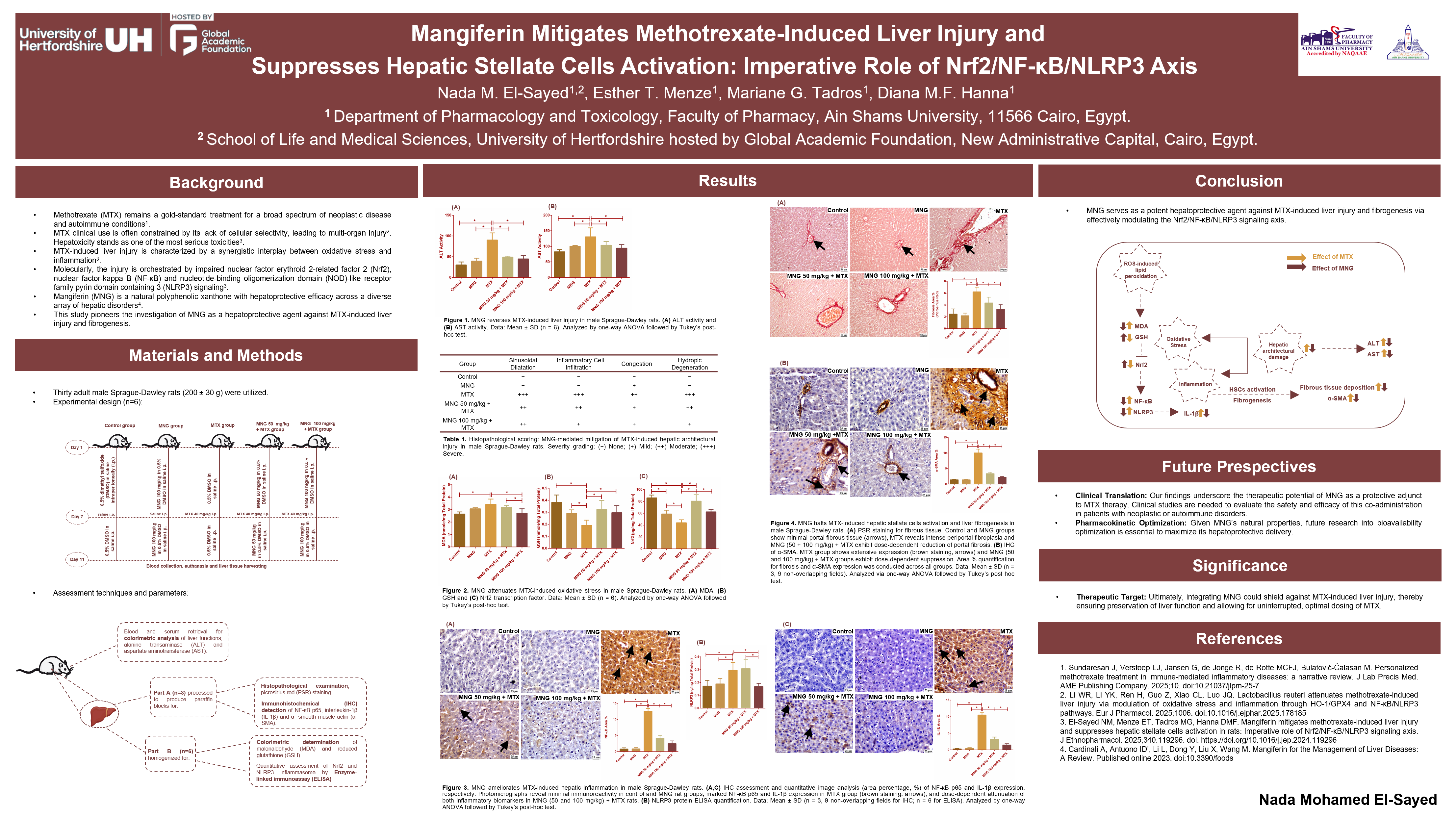
Methotrexate (MTX) is a cornerstone in the management of inflammatory rheumatic disorders and a diversity of malignancies. Its long-term use has been strongly associated with liver injury and, ultimately, liver fibrosis; significantly restraining its clinical utilization. Mangiferin (MNG), a natural polyphenolic xanthone, has garnered substantial interest given its broad spectrum of pharmacological activities, including antioxidant, anti-inflammatory and anti-fibrogenic properties in a vast array of cancerous and non-cancerous conditions. MNG has been a major bioactive element in over 40 polyherbal products in traditional Chinese medicine, and two prominent anti-inflammatory, immunomodulatory and antiviral Cuban formulations. This study aimed to pioneer in exploring the hepatoprotective role of MNG against MTX-induced liver injury and fibrogenesis.
Methods
Male Sprague-Dawley rats were, randomly, distributed into five groups; two of which were administered MNG 50 mg/kg and MNG 100 mg/kg intraperitoneally (i.p.) for ten days, and a single i.p. injection of MTX 40 mg/kg on the seventh day to establish hepatotoxicity. Blood and liver tissue samples were retrieved from all study groups and analyzed for liver functions, histopathological alterations, and oxidative stress, inflammatory, and fibrotic biomarkers.
Results
MNG restored the MTX-induced degenerations in hepatic architecture and function. Moreover, it combated the MTX-elicited oxidative stress evidently by the significantly attenuated hepatic tissue levels of malondialdehyde, and the significantly elevated reduced glutathione and Nrf2 levels. MNG also halted inflammation depicted by the downregulation of the NF-κB/NLRP3 inflammasome axis. It further demonstrated anti-fibrogenic potential as evidenced by the significant reduction in fibrous tissue deposition and hepatic expression of α-SMA.
Conclusions
The current study proved the hepatoprotective, and anti-fibrogenic effects of MNG against MTX-induced hepatotoxicity via the downregulation of NF-κB/NLRP3 inflammasome signaling axis, preceded by the amelioration of oxidative stress and Nrf2 signaling upregulation.
Leave A Comment