
Fatima Zohra Alaoui Ismaili
Morocco
Uncovering βS Haplotype Diversity in Morocco: Key Determinants of HbF Levels in Sickle Cell Disease
Fatima Zahra ALAOUI ISMAILI1, Amina BARAKAT1, Naima GHAILANI NOUROUTI1, and Mohcine BENNANI MECHITA1
1. Intelligent Automation & BioMed Genomics Laboratory, Faculty of Sciences and Techniques of Tangier, University Abdelmalek Essaâdi, Tangier, Morocco
Abstract
Background
Sickle cell disease (SCD) is the most common inherited blood disorder worldwide. Although monogenic, SCD displays wide clinical heterogeneity influenced by genetic modifiers such as β-globin gene cluster haplotypes and fetal hemoglobin (HbF) levels. Morocco represents a genetically diverse population due to its complex migration history, yet systematic studies exploring βS haplotype distribution among Moroccan patients remain scarce. Understanding local haplotype patterns is crucial for improving clinical management and assessing genotype–phenotype correlations.
This pilot cross-sectional study aimed to (i) characterize the βS haplotype distribution among Moroccan patients with sickle cell anemia and (ii) evaluate the association between these haplotypes and HbF levels.
Methods
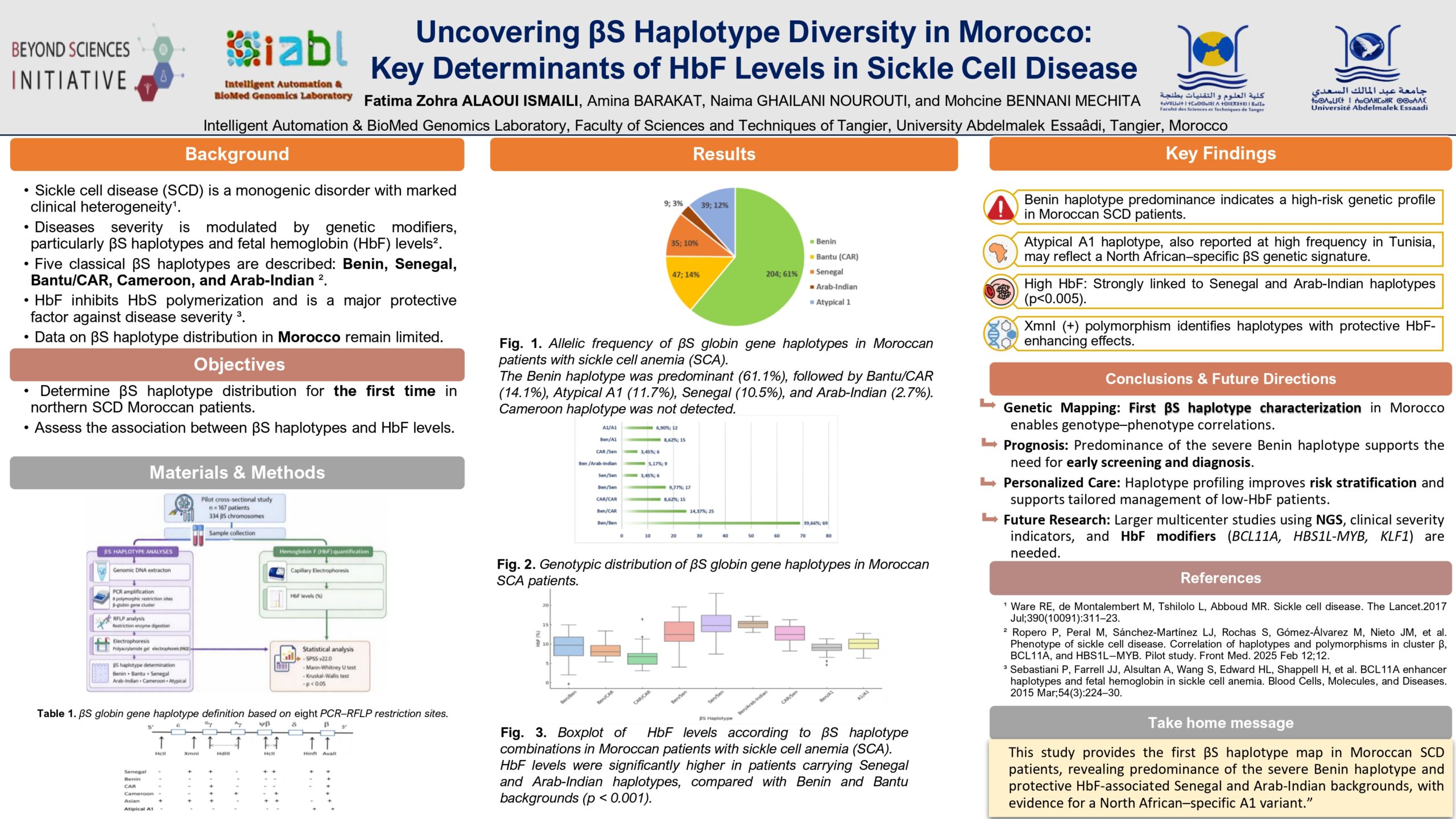
Eight polymorphic sites within the β-globin gene cluster were analyzed using PCR–RFLP in 334 chromosomes from SCD patients originating from northern Morocco. HbF levels were quantified by capillary electrophoresis. Statistical analyses were performed using SPSS 22.0 to evaluate associations between haplotypes and HbF levels. The Mann–Whitney U test was used to compare HbF levels between haplotypes, and the Kruskal–Wallis test was applied for multiple group comparisons. A p-value < 0.05 was considered statistically significant. Results The Benin haplotype was the most common (61.1%), followed by Bantu (14.1%), Atypical A1 (11.7%), Senegal (10.5%), and Arab-Indian (2.7%). The most commun genotypes were Ben/Ben (41.3%), Ben/CAR (15%), and Ben/Sen (10.2%). HbF levels varied significantly across haplotypes (p<0.005). The Senegal and Arab-Indian haplotypes were associated with the highest HbF levels (Sen/Sen: 16.4 ± 4.9%, Ben/Arab-Indian: 15.4 ± 1.07%), whereas the Benin and Bantu haplotypes showed the lowest (Ben/Ben: 8.43 ± 3.16%). Conclusions This study provides the first detailed description of βS haplotype distribution in Moroccan SCD patients and highlights substantial genetic and anthropological diversity, likely reflecting historical African gene flow. The predominance of the Benin haplotype—often associated with more severe disease—underscores the urgent need for early diagnosis, national screening programs, and tailored clinical management. Integrating haplotype information into routine evaluation may enhance prognostic accuracy and ultimately contribute to more personalized and effective care for patients with SCD in Morocco.
Leave A Comment