
Manahil Imran
Pakistan
Exploring Soil Streptomyces as a Source of Antimicrobial Metabolites Against Multidrug-Resistant Pathogens
Manahil Imran1, Saba Kiran1, Saman Taj1, Waqar Rauf1, Mazhar Iqbal1
1. Health Biotechnology Division. National Institute for Biotechnology and Genetics Engineering, Pakistan Institute of Engineering & Applied Sciences (NIBGE-C, PIEAS), Jhang Road, Faisalabad, Pakistan.
Abstract
Background
Multidrug-resistant (MDR) pathogens have severely compromised the effectiveness of current therapeutics, underscoring the urgent need for new antimicrobial agents. Actinomycetes, particularly soil-derived Streptomyces species, are well-established producers of structurally diverse secondary metabolites with potent biological activities. Exploring indigenous Streptomyces strains offers a promising strategy for discovering novel antimicrobials that can address region-specific challenges in combating antimicrobial resistance.
Methods
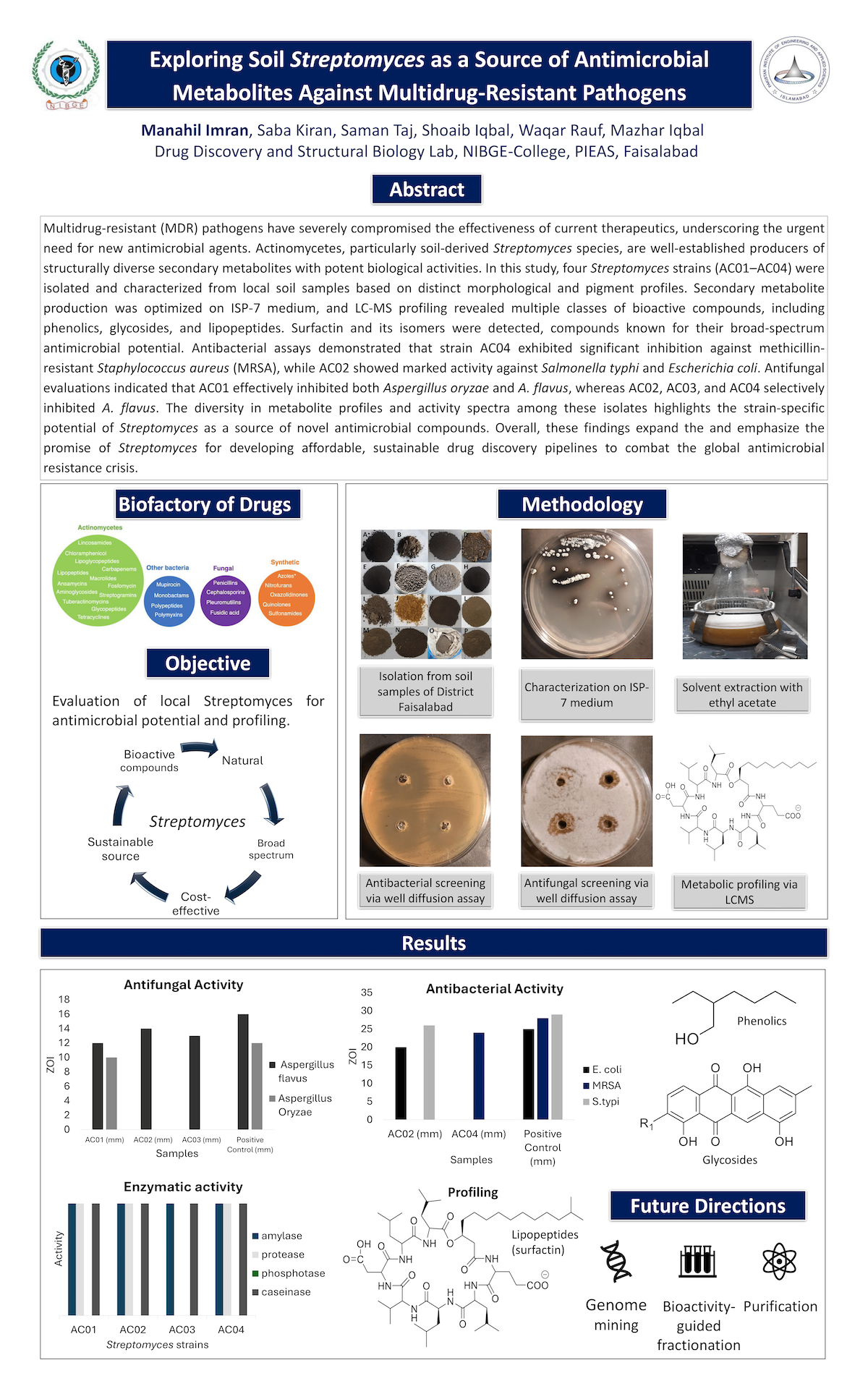
our Streptomyces strains (AC01–AC04) were isolated from local soil samples and characterized based on distinct morphological features and pigment production. Secondary metabolite production was optimized using ISP-7 medium. Crude extracts from each strain were subjected to LC–MS profiling to identify major classes of bioactive compounds. Antibacterial activity was assessed against Escherichia coli, Salmonella typhi, and methicillin-resistant Staphylococcus aureus (MRSA), while antifungal activity was evaluated against Aspergillus oryzae and A. flavus using standard agar diffusion assays.
Results
LC–MS profiling revealed multiple classes of bioactive metabolites, including phenolics, glycosides, and lipopeptides. Notably, surfactin and its isomers were detected, compounds well known for their broad-spectrum antimicrobial potential.
Antibacterial activity: Strain AC04 showed significant inhibition against MRSA, while AC02 exhibited strong activity against S. typhi and E. coli.
Antifungal activity: AC01 effectively inhibited both A. oryzae and A. flavus. AC02, AC03, and AC04 selectively inhibited A. flavus.
The observed variation in metabolite diversity and activity among strains demonstrates the strain-specific biosynthetic capacity of the isolates.
Conclusions
This study highlights the substantial antimicrobial potential of locally isolated Streptomyces strains. The detection of surfactin-related lipopeptides and other bioactive compounds, along with the diverse antibacterial and antifungal activity patterns, demonstrates the promise of these isolates as sources of new antimicrobial agents. Overall, the findings expand the natural product repertoire of indigenous actinomycetes and emphasize their value in developing affordable and sustainable drug discovery pipelines to combat the global antimicrobial resistance crisis.
Leave A Comment