
Taras Zadvornyi
Ukraine
Association of Collagen Maturity with the Clinicopathological Characteristics of Prostate Cancer
Zadvornyi T., Mushii O., Pavlova A., Burda T., Shevchuk A., Lukianova N.
R.E. Kavetsky Institute of Experimental Pathology, Oncology and Radiobiology of the National Academy of Sciences of Ukraine, Kyiv, Ukraine
Abstract
Background
It has been demonstrated that extracellular matrix (ECM) remodeling plays a key role in the progression of malignant neoplasms. Alterations in the spatial organization, structure, and qualitative composition of the ECM significantly affect the behavior of both malignantly transformed cells and immune cells, determining their migratory activity. Collagen is one of the main structural components of the ECM; it provides the mechanical support of tissues, shapes the architecture of the tumor stromal framework, and participates in the regulation of intercellular signaling. Disruptions in its organization—including changes in fiber thickness, density, orientation, and degree of cross-linking—are associated with an increased invasive potential of tumors, the formation of an aggressive phenotype, and the development of metastatic disease. The aim: to analyze the relationship between the maturity of the collagen matrix of neoplasms and the aggressiveness of prostate cancer (PCa) progression.
Methods
Materials and methods. The study used tumor tissue samples from patients with PCa stages II–IV treated at the National Cancer Institute (Kyiv, Ukraine) in 2015–2024. The maturity of collagen fibers in PCa tissue was evaluated using Picrosirius Red histochemical staining. Quantitative analysis was performed on microphotographs obtained with an Olympus BX53 polarizing microscope (Evident, Japan). Morphometric analysis was conducted using ImageJ and CurveAlign 4.0 beta software. Statistical analysis was carried out using GraphPad Prism 10.
Results
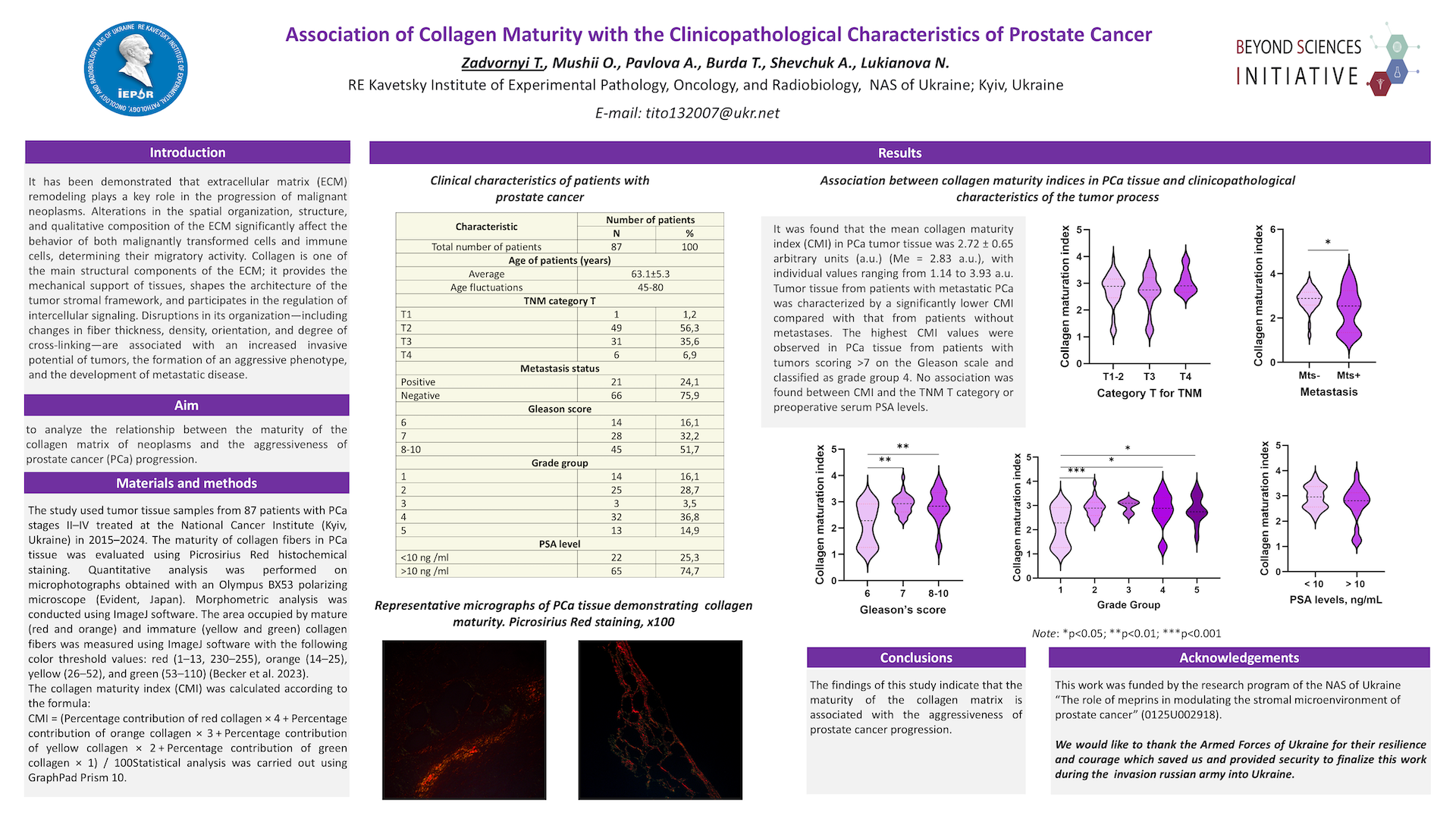
Results. It was found that the mean collagen maturity index (CMI) in PCa tumor tissue was 2.72 ± 0.65 arbitrary units (Me = 2.83 a.u.), with individual variations ranging from 1.14 to 3.93 a.u. Tumor tissue from patients with metastatic PCa was characterized by a significantly lower CMI compared to that of patients without metastases. The highest CMI values were observed in PCa tissue from patients with tumors scoring >7 on the Gleason scale and group 4. No association was found between CMI and tumor stage, TNM T category, or preoperative serum PSA level.
Conclusions
The findings of this study indicate that the maturity of the collagen matrix is associated with the aggressiveness of prostate cancer progression.
Funding
This work was funded by the research program of the NAS of Ukraine “The role of meprins in modulating the stromal microenvironment of prostate cancer” (0125U002918).
Leave A Comment