
Samuel Appiagyei
Ghana
The incidence of surgical site infections after emergency abdominal surgeries; a longitudinal study at Korle Bu Teaching Hospital, Surgical Departmen
Samuel Appiagyei1,2, Antoinette Bediako-Bowan1,3, Gloria Asare1, Felicia Amezugbe1
1. University of Ghana Medical School, Accra, Ghana
2. Urology and Nephrology Center of Excellence, Korle Bu Teaching Hospital, Accra, Ghana
3. Surgical Department, Korle Bu Teaching Hospital, Accra, Ghana
Abstract
Background
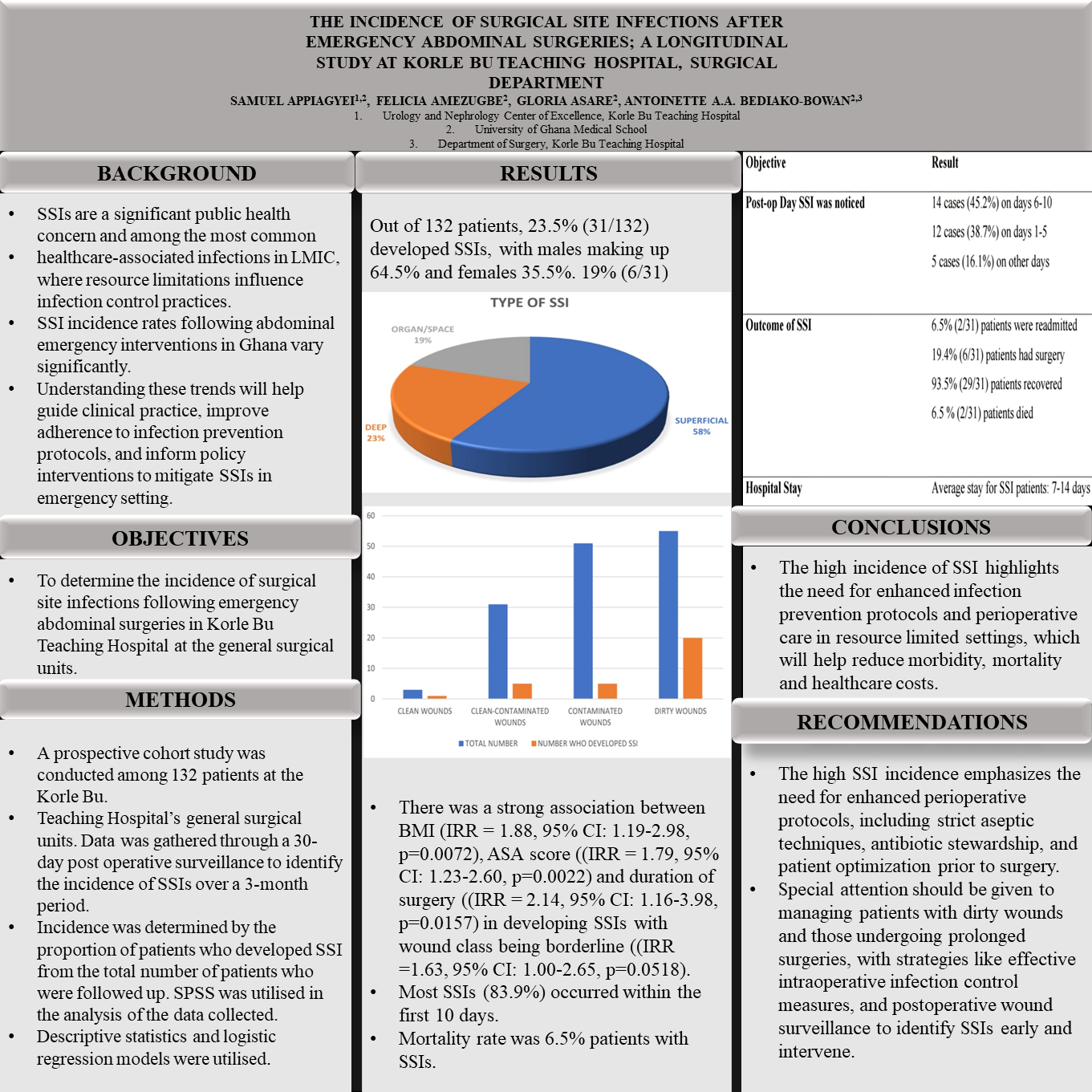
Background: SSIs are a significant public health concern and among the most common healthcare-associated infections in LMIC, where resource limitations influence infection control practices. SSI incidence rates following abdominal emergency interventions in Ghana vary significantly. Understanding these trends will help guide clinical practice, improve adherence to infection prevention protocols, and inform policy interventions to mitigate SSIs in emergency setting
Methods
Methods: A longitudinal was conducted among 132 patients at the Korle Bu
Teaching Hospital’s general surgical units. Data was gathered through a 30-day post
operative surveillance to identify the incidence of SSIs over a 3-month period. Incidence was determined by the proportion of patients who developed SSI from the total number of patients who were followed up. SPSS was utilised in the analysis of the data collected. Descriptive statistics and logistic regression models were utilised.
Results
Results: 132 patients were followed up for 30 days post-operation. 23.5% (31/132)
developed SSIs, with males making up 64.5% and females 35.5%. Majority of SSIs were superficial 58% (18/31), followed by deep incisional 23% (7/31) and then organ/space19% (6/31). There was a strong association between BMI (IRR = 1.88, 95% CI: 1.19-2.98, p=0.0072), ASA score ((IRR = 1.79, 95% CI: 1.23-2.60, p=0.0022) and duration of surgery ((IRR = 2.14, 95% CI: 1.16-3.98, p=0.0157) in developing SSIs with wound class being borderline (IRR =1.63, 95% CI: 1.00-2.65, p=0.0518). Most SSIs (83.9%) occurred within the first 10 days. Mortality rate was 6.5% patients with SSIs.
Conclusions
Conclusion: The high incidence of SSI highlights the need for enhanced infection
prevention protocols and perioperative care in resource limited settings, which will help
reduce morbidity, mortality and healthcare costs.
Leave A Comment