
Fadoua Louglali
Morocco
How Gallstone Surface Properties Shape Salmonella Typhi Adhesion and Potential Carcinogenic Risk?
Fadoua Louglali1, Abdeslam Jaafari1, Hafida Zahir1, Mostafa EL Louali1, and Hassan Latrache1
1. Department of Life Sciences, Faculty of Sciences and Techniques, Sultan Moulay Slimane University, BP 523, 23000 Beni-Mellal, Morocco.
Abstract
Background
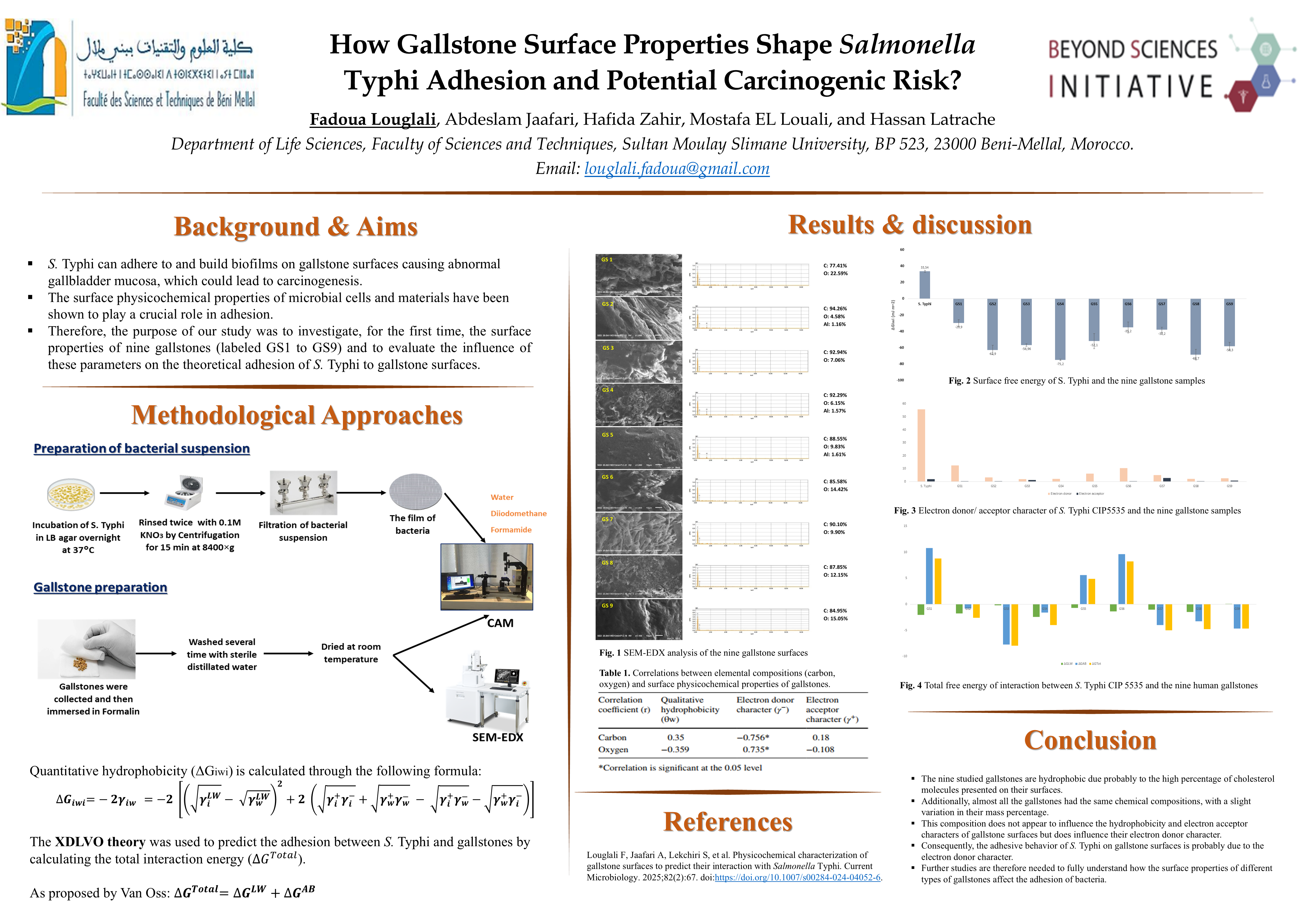
Salmonella Typhi (S. Typhi) is known to adhere to and form biofilms on gallstone surfaces, an interaction that can induce chronic inflammation of the gallbladder mucosa and potentially contribute to carcinogenic processes. The surface physicochemical properties of microbial cells and gallstones have been shown to play a crucial role in adhesion. This study investigated, for the first time, the surface properties of nine gallstones and evaluated the influence of these parameters on the theoretical adhesion of S. Typhi to gallstone surfaces.
Methods
The physicochemical properties were determined by SEM–EDX and contact angle measurements (CAM) while the predictive adhesion of S. Typhi on gallstones was estimated using the XDLVO approach.
Results
SEM-EDX analysis revealed that cholesterol is the principal component on the surface of all gallstones, with carbon and oxygen as the main elements. Aluminum was detected as a trace element in only three gallstones: GS2, GS4, and GS5. S. Typhi CIP5535 has a hydrophilic character (ΔGiwi = 33.54 mJ m-2), as well as strong electron-donor (γ-= 55,80 mJ m-2) and weak electron-acceptor properties (γ+ = 1,95 mJ m-2). Regarding gallstones, it was found that they have a hydrophobic character (ΔGiwi between -29,9 mJ m-2 and -75,2 mJ m-2), while their electron donor/acceptor characters change according to each gallstone. Predictive adhesion showed that all gallstones could be colonized by S. Typhi 〖(ΔG〗_XDLVO^Total<0) except GS1, GS5, and GS6 〖(ΔG〗_XDLVO^Total>0).
Conclusions
These results highlight the importance of interfacial physicochemistry in regulating bacterial colonization and provide insight into potential strategies to limit or prevent S. Typhi adhesion, thereby mitigating its long-term carcinogenic risk in the biliary environment.
Leave A Comment