
Rania Prya Muthusamy Rengasamy
Morocco
Identification of diagnostic and prognostic biomarkers in triple-negative breast cancer via integrated bioinformatics analysis
Muthusamy Rengasamy Rania Prya1, Alsamman Mohammed2, Abdullah Samir Manar 3, Barakat Amina1, Ghailani Nourouti Naima1, Bennani Mechita Mohcine1, Bakkach Joaira4
1.Intelligent Automation & BioMedGenomics Laboratory, Faculty of Sciences and Techniques of Tangier, University Abdelmalek Essadi, Morocco.
2.Oklahoma Medical Research Foundation 825 NE 13th St. Oklahoma City, OK 73104
3.Zewail City of Science and Technology, Cairo, Egypt.
4.Higher Institute of Nursing Professions and Health Techniques of Tetouan, Morocco.
Abstract
Background
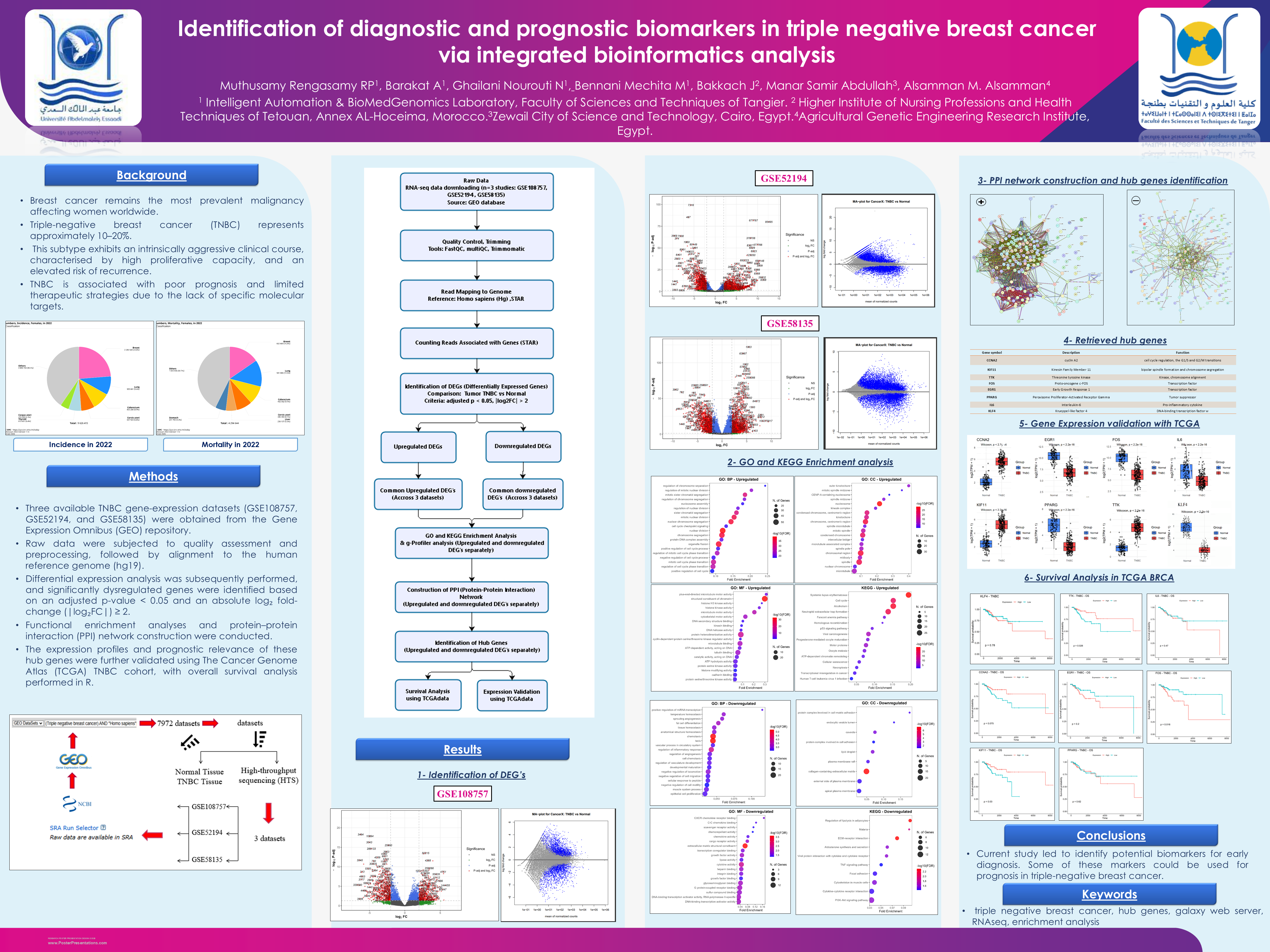
Breast cancer remains the most prevalent malignancy affecting women worldwide. Among its molecular subtypes, triple-negative breast cancer (TNBC) represents approximately 10–20% of all diagnosed cases and is distinguished by the absence of estrogen receptor, progesterone receptor, and HER2 overexpression. This subtype exhibits an intrinsically aggressive clinical course, characterised by high proliferative capacity, and an elevated risk of recurrence. Despite substantial progress in breast cancer therapeutics, TNBC continues to be associated with poor prognosis and limited therapeutic strategies due to the lack of specific molecular targets. This study aims to identify novel potential biomarkers for TNBC that may serve in early diagnosis and enhance survival outcomes, using advanced bioinformatics tools, to identify key genes, perform functional enrichment and pathway analyses to elucidate the biological processes and signaling pathways involved in TNBC pathogenesis.
Methods
Three available TNBC gene-expression datasets (GSE108757, GSE52194, and GSE58135) were obtained from the Gene Expression Omnibus (GEO) repository. Raw data were subjected to quality assessment and preprocessing, followed by alignment to the human reference genome (hg19). Differential expression analysis was subsequently performed, and significantly dysregulated genes were identified based on an adjusted p-value < 0.05 and an absolute log₂ fold-change (|log₂FC|) ≥ 2. Functional enrichment analyses and protein–protein interaction (PPI) network construction were then conducted to elucidate the biological processes and molecular pathways associated with TNBC and to identify potential hub genes. The expression profiles and prognostic relevance of these hub genes were further validated using The Cancer Genome Atlas (TCGA) TNBC cohort, with overall survival analysis performed in R.
Results
Differential expression analysis identified 1,088 DEGs in GSE108757, 6,657 in GSE52194, and 4,066 in GSE58135. Functional enrichment analyses demonstrated that these genes are involved in key biological pathways implicated in TNBC pathogenesis, including “regulation of chromosome separation,” “mitotic sister chromatid segregation,” “regulation of angiogenesis,” and “extracellular matrix organization.” Construction of the PPI network further highlighted eight central hub genes KIF11, TTK, FOS, EGR1, CCNA2, IL6, PPARG, and KLF4 which exhibit high connectivity and may play pivotal roles in TNBC progression. These hub genes represent promising candidates for targeted therapy development and may serve as potential biomarkers for future translational research in TNBC.
Conclusions
Current study led to identify potential biomarkers for early diagnosis. Some of these markers could be used for prognosis in triple-negative breast
cancer.
Leave A Comment