
Joaira Bakkach
Morocco
Identification of Potential HubGenes and Key Pathways among breast cancer and other cancer types Using A systematic Bioinformatics Approach
Bakkach Joaira1, Mahmoud Alsamman Alsamman 2, Younes Salma 3, I. Al-Dewik Nader 4,5,6,7, Uddin Shahab 8, El allali Achraf 9, Zayed Hatem 10
1 Higher Institute of Nursing Professions and Health Techniques of Tetouan, Morocco.
2 Oklahoma Medical Research Foundation, 825 NE 13th St. Oklahoma City, OK 73104, USA.
3 Department of Research, Women’s Wellness and Research Center, Hamad Medical Corporation, Doha 3050, Qatar.
4 Interim Translational Research Institute (iTRI), Hamad Medical Corporation (HMC), Doha, Qatar
5 Faculty of Health and Social Care Sciences, Kingston University, St. George’s University of London, London KT1 2EE, UK.
6 Clinical and Metabolic Genetics, Department of Pediatrics, Hamad General Hospital, Hamad Medical Corporation, Doha 3050, Qatar.
7 College of Health and Life Science (CHLS), Hamad Bin Khalifa University (HBKU), Doha 34110, Qatar
8 Translational Research Institute and Dermatology Institute, Academic Health System, Hamad Medical Corporation (HMC) Doha 3050, Qatar.
9 African Genome Center, Mohammed VI Polytechnic University, Ben Guerir, Morocco.
10 Department of Biomedical Science, College of Health Sciences, Qatar University, Doha, Qatar.
Abstract
Background
The underlying molecular pathways of tumorigenesis in breast cancer remain to be fully elucidated. We aimed to identify the most frequently reported and differentially expressed genes (DEGs) in breast cancer and those shared with other cancers.
Methods
We perform text mining analysis for 171,870 published articles on breast, ovarian, pancreatic, prostate, and thyroid cancers. Twenty-two datasets from Gene Expression Omnibus (GEO) representing the five cancers (739 patients and 364 controls) were used to identify DEGs, which were analyzed using the limma package. Gene Ontology (GO), Kyoto Encyclopedia of Genes and Genomes (KEGG) and WikiPathways (WP) analyses were conducted through g:Profiler and ShinyGO. The protein-protein interaction (PPI) network was established through the STRING (Search Tool for the Retrieval of Interacting Genes database) website and visualized by Cytoscape.
Results
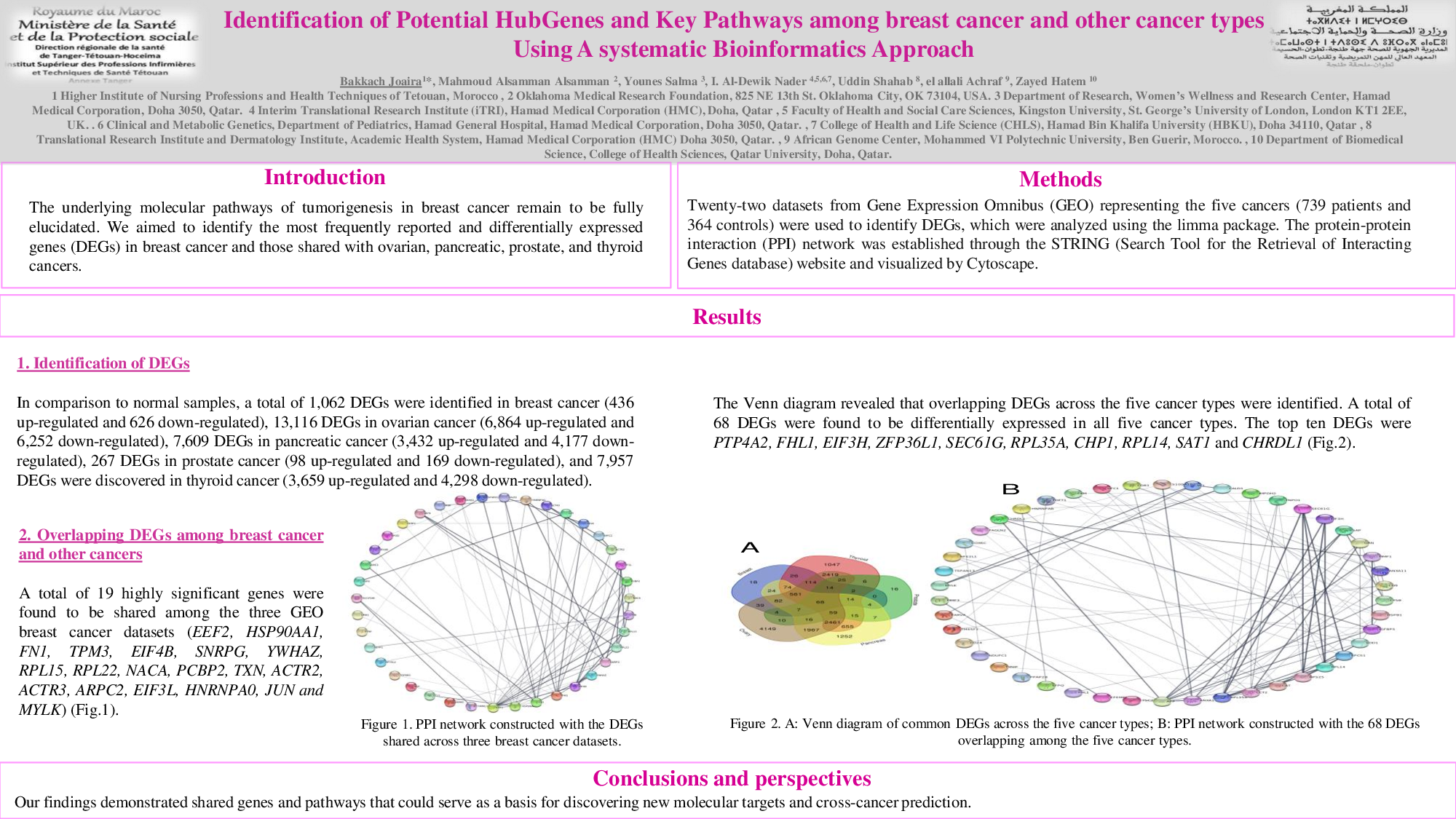
A total of 814 genes were highly frequent in breast cancer. In total, 70 genes were overlapping across the five types of cancer and were mainly involved in enzyme binding, phosphorylation, endocrine resistance and breast cancer pathway. Analysis of publicly available gene expression data revealed 1062 DEGs in breast cancer (436 up-regulated and 626 down-regulated). In total, 19 highly significant DEGs were shared between three GEO breast cancer datasets andwere enriched in the immune system process, cell cycle and cell growth. EEF2, HSP90AA1, FN1, TPM3, EIF4B, YWHAZ, SNRPG, RPL22, RPL15 and TXN were the most interactive ten DEGs. A total of 68 DEGs were found to overlap between all five types of cancer. The most important enriched pathways were cell migration and cell death, among other biological processes. The top ten most interactive DEGs were APP, ANXA1, RPL35A, CCT2, CAT, RPS25, RPL14, SPCS1, SOD1 and IGFBP5
Conclusions
Our findings demonstrated shared genes and pathways that could serve as a basis for discovering new molecular targets and cross-cancer prediction.
Leave A Comment