
Celina Yung-Ai Lin Lee
Brazil
Standardization and Characterization of Growth Dynamics in Multicellular Tumor Spheroids of Bladder Cancer Cell Lines
Celina Yung-Ai Lin Lee1, Anna Gabriele Prado dos Santos1, Andresa Hiromi Sakai1, Flávia Eliza Staut Silva1, Arthur Mikalixen1, Giedre Vigo Duarte de Freitas1, Juliana Mara Serpeloni1
1. General Biology Department, State University of Londrina, Londrina, Brazil
Abstract
Background
BACKGROUND: Bladder cancer is a global health issue with over 570,000 cases per year around the world. Cell culture remains one of the main tools for screening new chemotherapeutic drugs; however, traditional culture models fail to reproduce the tumor microenvironment, resulting in low predictive efficacy. This limitation highlights the importance of using multiple screening models, such as multicellular tumor spheroids (MCTs), which are non-adherent 3D structures formed by spontaneous cellular aggregation and recapitulate several key characteristics of avascular solid tumors. This study aims to standardize and analyze the growth profiles of various bladder cancer cell lines to support future in vitro screening of new anticancer compounds by our research group.
Methods
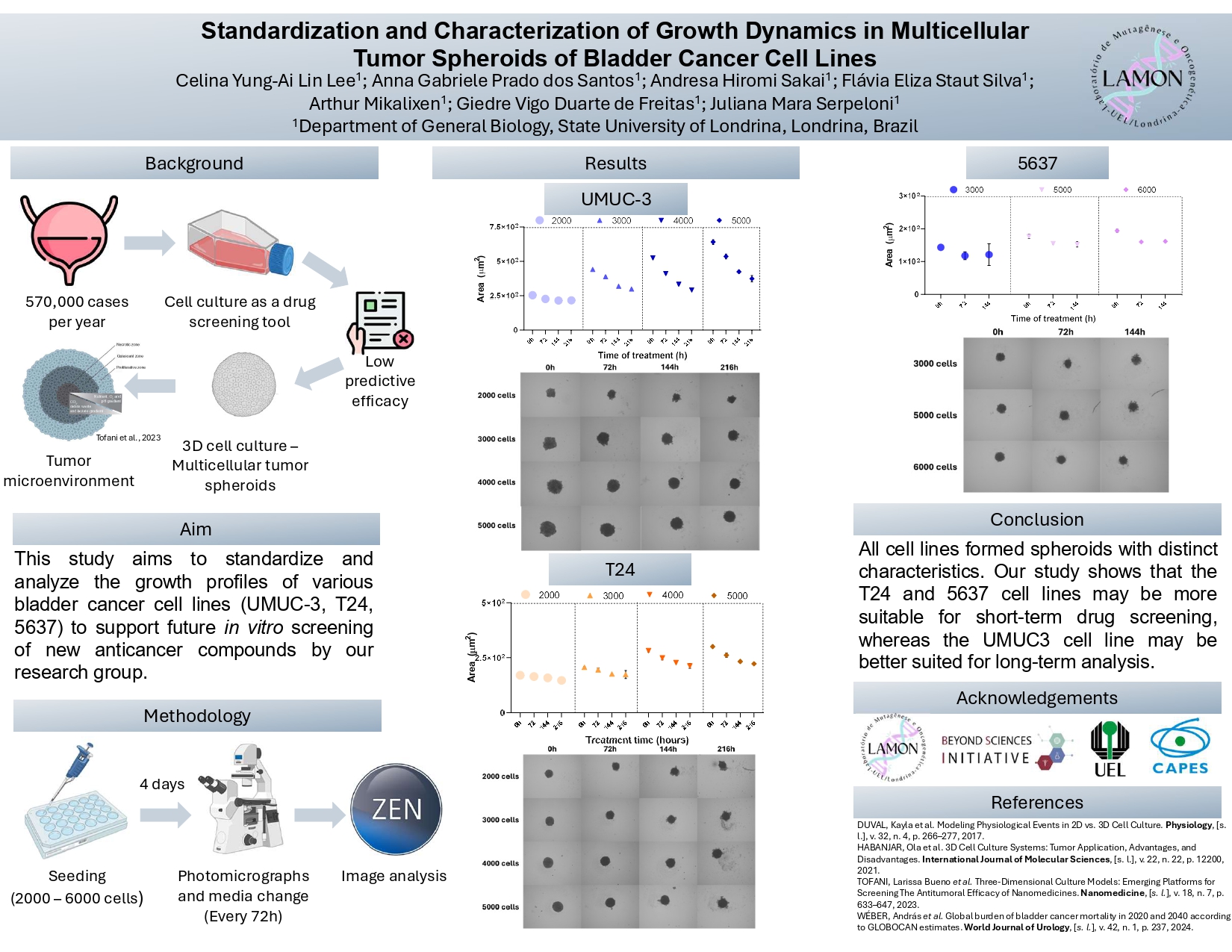
METHODS: Different cell densities of UMUC3, T24 (2000–5000 cells), and 5637 (3000–6000 cells) bladder cancer cell lines were seeded in agarose-coated 96-well plates and left undisturbed for 96 h to allow spheroidization. The growth analysis was performed from day 1 (96h after spheroid formation) to day 9. Cell media was changed every 72 h, and photomicrographs were taken before each change, up to 9 days (216 h). Spheroid area measurement was performed using the software Zen.
Results
RESULTS: All three cell lines formed MCTs after 96 h, and they showed size reduction over time. The UMUC3 cell line formed rounded yet irregular compact aggregates that ranged from 253.7 µm2 to 640.6 µm2, depending on the initial cell number, and which compacted over the days, resulting in well-defined spherical MCTs. The T24 cell line formed round, compact spheroids with areas ranging from 170.2 µm2 to 300.8 µm2 and the MTCs acquired irregular morphology after 144 h of spheroid formation, especially at lower seeding densities (2000 and 3000 cells). Finally, the 5637 cell line initially formed compact spheroids with similar sizes ranging from 143.4 µm2 to 194.0 µm2, which presented a prominent quiescent/necrotic zone and a smaller, irregular proliferative zone; their MTCs resulted in progressive loosening and disaggregation over time, with spheroid disintegration at 144 h at lower seeding densities and reduced viability at higher seeding densities.
Conclusions
CONCLUSION: All cell lines formed MCTs with distinct characteristics. Our study shows that the T24 and 5637 cell lines may be more suitable for short-term drug screening, whereas the UMUC3 cell line may be better suited for long-term analysis.
Leave A Comment