
Poonam Daga
India
Comparative Antiproliferative Activity in Luminal A and Triple-Negative Breast Cancer Models
Poonam Banthia1, Rishi Vyas2, Ankur Jain3, Dhiraj Daga4, Takayuki Ichikawa5,Vaibhav Kulshrestha6, Lokesh Gambhir7,Neha Kapoor8 and Gaurav Sharma8
1Department of Health Sciences, Central University of Rajasthan, Bandersindri, Ajmer, Rajasthan, India
2Department of Physics, Swami Keshvanand Institute of Technology, Management & Gramothan, Jaipur, Rajasthan, India
3Centre for Renewable Energy & Storage, Suresh Gyan Vihar University, Jaipur, Rajasthan, India
4Department of Radiation Oncology, Jawahar Lal Nehru Medical College and Hospital, Ajmer, Rajasthan, India
5Graduate School of Advanced Science and Engineering, Hiroshima University, Higashi-Hiroshima-739-8527, Japan
6CSIR- Central Salt & Marine Chemical Research Institute, Bhavnagar, Gujarat, India
7School of Basic and Applied Sciences, Shri Guru Ram Rai University, Dehradun, Uttarakhand, India
8School of Applied Sciences, Suresh Gyan Vihar University, Jaipur, Rajasthan, India
Abstract
Background
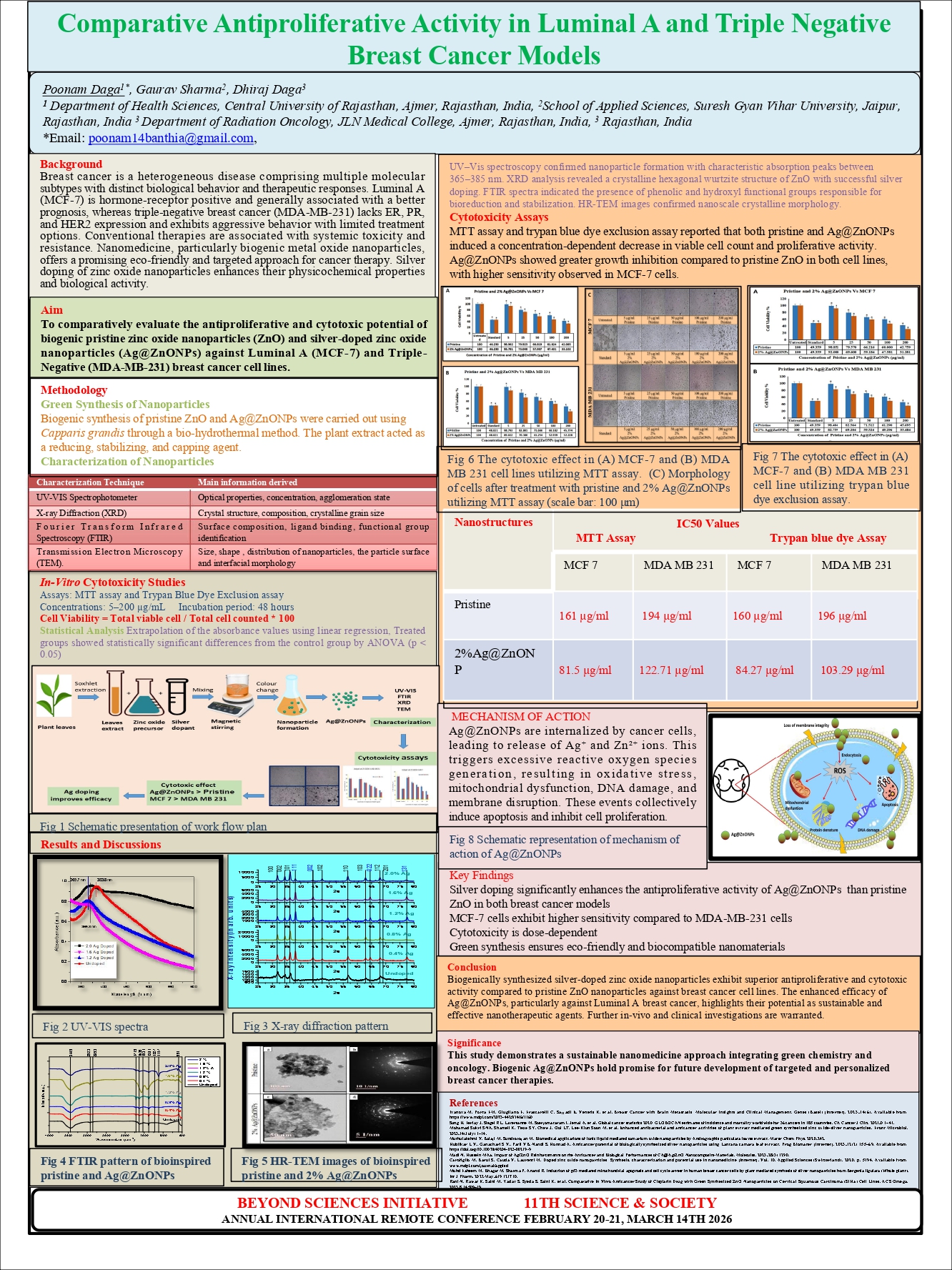
Breast cancer remains the most prevalent malignancy worldwide, affecting nearly 3 million women annually, with a projected 47% rise in global cancer burden by 2040. Its molecular heterogeneity, defined by ER/PR and HER2 expression, presents diverse subtypes such as hormone receptor-positive, HER2-enriched, and triple-negative breast cancer (TNBC). TNBC is characterized by aggressive biology, early metastasis, poor prognosis, and limited therapeutic options restricted largely to chemotherapy. The limitations and toxicity of conventional treatments underscore the urgent need for safer, targeted therapeutic strategies. Nanomedicine offers promising alternatives, with metal and metal oxide nanoparticles demonstrating superior physicochemical, antimicrobial, and anticancer properties. Biogenic synthesis using plant extracts offers an eco-friendly, cost-effective approach for fabricating functional nanoparticles with improved stability and biological properties.
Methods
Objective: Potential cytotoxicity activity of biogenic pristine (undoped) and silver-doped zinc oxide nanoparticles (Ag@ZnONPs) against MCF-7 (Luminal-A) and MDA-MB-231(Triple-negative) human breast cancer cell lines.
Methodology: The biogenic nanostructures were constructed by biohydrothermal method employing Capparis grandis and characterized by UV-Vis- spectrophotometry, FTIR, TEM, and XRD. The MTT and trypan-blue-dye exclusion assays were performed to assess antiproliferative, anti-carcinogenicity.
Results
The MTT assay revealed that reduction of viable tumor cell fraction is more promising for silver-doped zinc oxide nanoparticles (IC50 81.5 µg/ml, 122.71 µg/ml ) than for undoped zinc oxide nanoparticles (IC50 161 µg/ml, 194 µg/ml) against MCF-7 and MDA-MB-231 breast cancer cell lines, respectively at 200 µg/ml dose concentration. The growth inhibitory effect of Ag@ZnONPs is greater against MCF-7 cells than MDA-MB-231 cells.
Conclusions
This is the first study to report the anti-carcinogenic potential of Ag@ZnONPs using Capparis grandis leaf extract. It concluded that that the antiproliferative potential of nanostructures towards oncogenic cells depends on the structure, doping and dose of nanostructures and type of cell lines used.
Leave A Comment