
Fatima Zahrae Bartal
Morocco
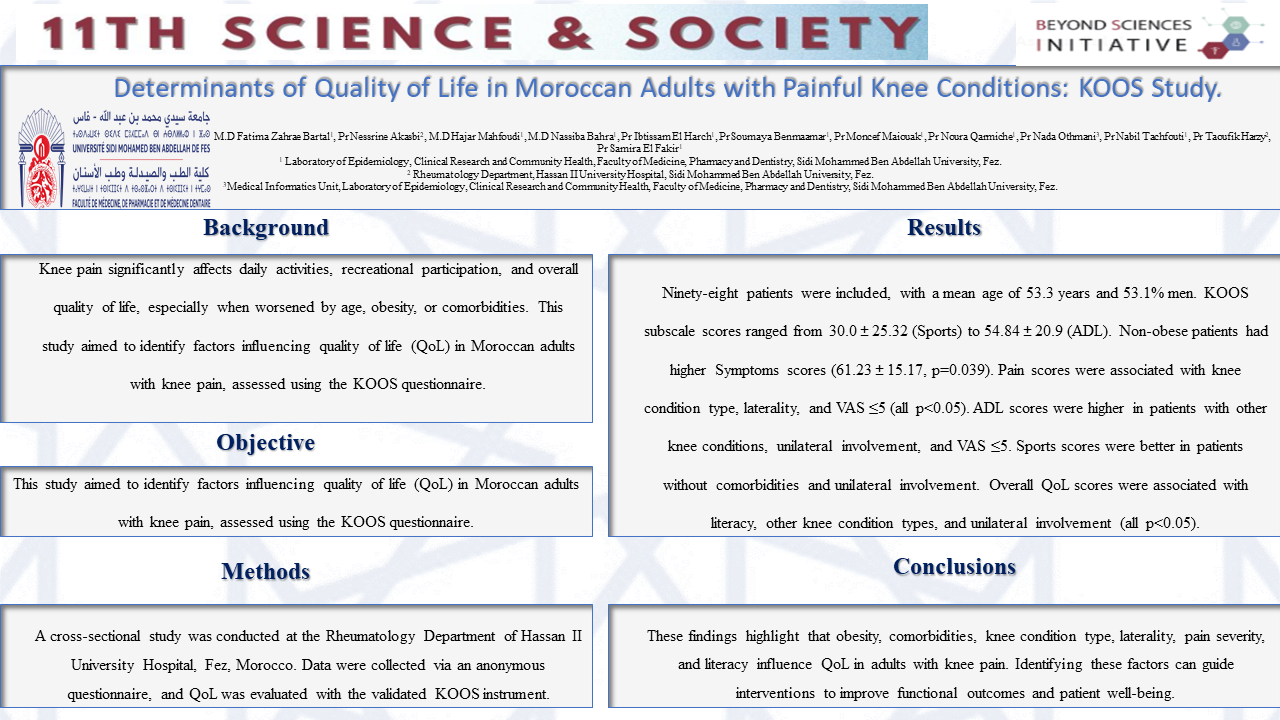
Determinants of Quality of Life in Moroccan Adults with Painful Knee Conditions: KOOS Study.
Fatima Zahrae Bartal1, Nessrine Akasbi2, Hajar Mahfoudi1, Nassiba Bahra1, Ibtissam El Harch1, Soumaya Benmaamar1, Moncef Maiouak1, Noura Qarmiche1, Nada Othmani3, Nabil Tachfouti1, Taoufik Harzy2, Samira El Fakir1
1 Laboratory of Epidemiology, Clinical Research and Community Health, Faculty of Medicine, Pharmacy and Dentistry, Sidi Mohammed Ben Abdellah University, Fez.
2 Rheumatology Department, Hassan II University Hospital, Sidi Mohammed Ben Abdellah University, Fez.
3Medical Informatics Unit, Laboratory of Epidemiology, Clinical Research and Community Health, Faculty of Medicine, Pharmacy and Dentistry, Sidi Mohammed Ben Abdellah University, Fez.
Abstract
Background
Knee pain significantly affects daily activities, recreational participation, and overall quality of life, especially when worsened by age, obesity, or comorbidities. This study aimed to identify factors influencing quality of life (QoL) in Moroccan adults with knee pain, assessed using the KOOS questionnaire.
Methods
A cross-sectional study was conducted at the Rheumatology Department of Hassan II University Hospital, Fez, Morocco. Data were collected via an anonymous questionnaire, and QoL was evaluated with the validated KOOS instrument.
Results
Ninety-eight patients were included, with a mean age of 53.3 years and 53.1% men. KOOS subscale scores ranged from 30.0 ± 25.32 (Sports) to 54.84 ± 20.9 (ADL). Non-obese patients had higher Symptoms scores (61.23 ± 15.17, p=0.039). Pain scores were associated with knee condition type, laterality, and VAS ≤5 (all p<0.05). ADL scores were higher in patients with other knee conditions, unilateral involvement, and VAS ≤5. Sports scores were better in patients without comorbidities and unilateral involvement. Overall QoL scores were associated with literacy, other knee condition types, and unilateral involvement (all p<0.05). Conclusions These findings highlight that obesity, comorbidities, knee condition type, laterality, pain severity, and literacy influence QoL in adults with knee pain. Identifying these factors can guide interventions to improve functional outcomes and patient well-being.
Leave A Comment