
Hafsa Yafih
Sri Lanka
Misophonia among 10- 14-year-old adolescents in Matale Educational Division, Sri Lanka.
Hafsa Yafih1, Dumini de Silva2
1. Final year student, Department of disability studies, Faculty of Medicine, University of Kelaniya, Sri Lanka
2. Senior Lecturer II, Department of Disability Studies, Faculty of Medicine, University of Kelaniya, Sri Lanka
Abstract
Background
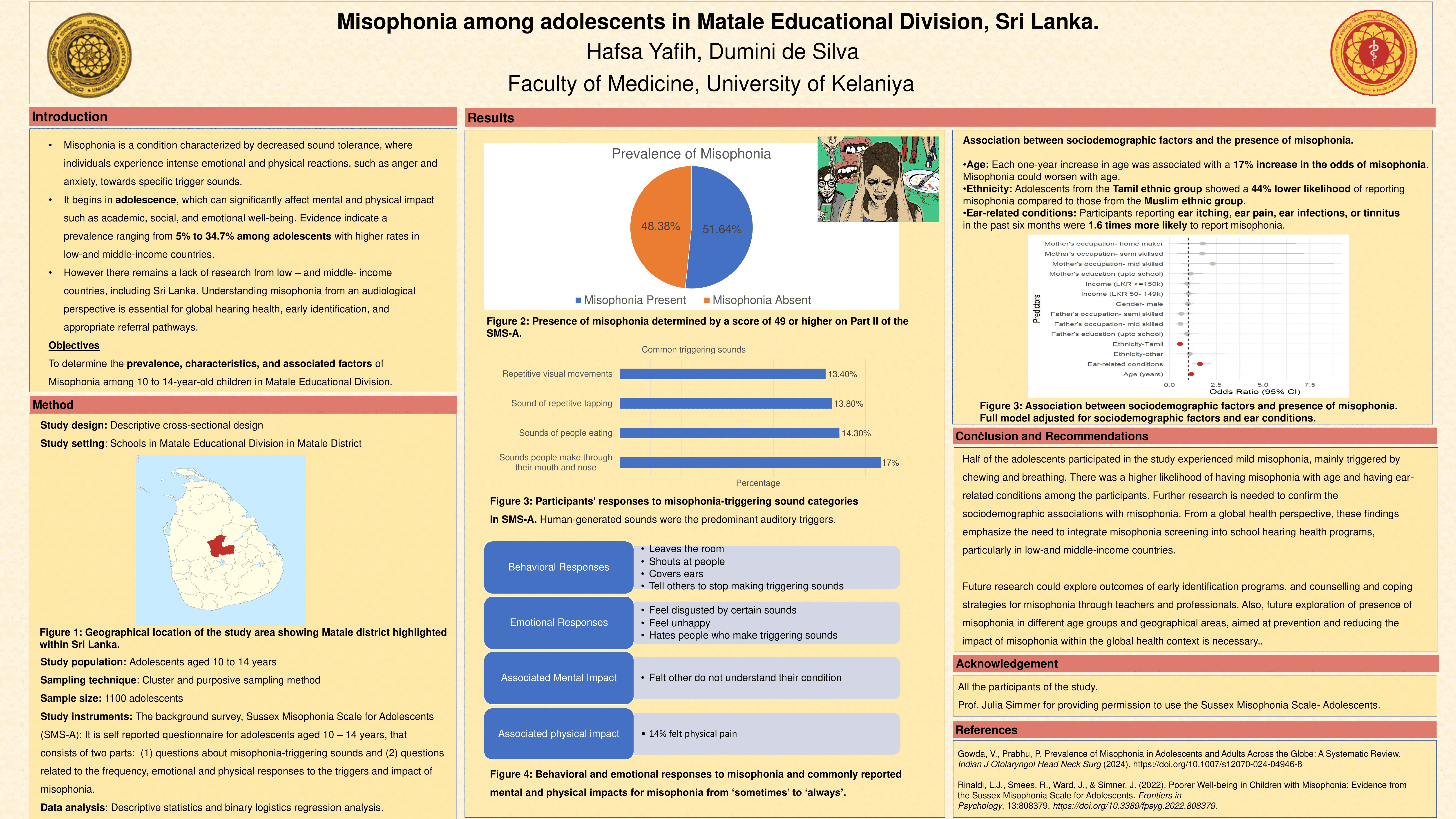
Background: Misophonia is a condition characterized by strong negative emotional and physiological reactions to specific trigger sounds, often resulting in significant mental and physical impairment. Evidence suggests that its onset typically occurs during childhood or early adolescence. Although misophonia has gained increasing international attention as a global health concern, there remains a lack of research from low- and middle-income countries, including Sri Lanka. Given the rising recognition of adolescent mental health issues in the region, understanding misophonia within its cultural and socioeconomic context is essential for improving early identification and informing appropriate interventions. To address this gap, the present study aimed to determine the prevalence, common auditory triggers, symptom patterns, and associated psychosocial factors of misophonia among Sri Lankan adolescents aged 10–14 years, contributing valuable data to the global evidence.
Methods
Methods: A cross-sectional survey was conducted among 1,100 students aged 10–14 years in the Matale Educational Division using the Sussex Misophonia Scale for Adolescents (SMS-A) administered in each participant’s preferred language, along with a structured background questionnaire. Participants were recruited from randomly selected schools within the division using a cluster and purposive sampling approach. Data were analyzed using descriptive statistics to summarize prevalence, triggers, and symptom patterns, and binary logistic regression to identify factors associated with misophonia symptoms.
Results
Results: The prevalence of misophonia among adolescents was 51.6%. The most commonly reported triggers were person-generated sounds and visual stimuli. Adolescents described prominent emotional reactions such as disgust, anger, and embarrassment, while behavioral responses often included avoidance and social withdrawal. Misophonia was more frequently experienced among certain demographic subgroups. Among the variables examined, age, ethnicity, and presence of ear conditions showed statistically significant associations with misophonia symptoms.
Conclusions
Conclusion: The findings emphasize the need for increased awareness, early screening, and school-based support systems. Incorporating misophonia evaluation into assessment protocols for patients with tinnitus and ear-related complaints. These findings provide essential baseline evidence for Sri Lanka and support future research exploring regional variations, wider age groups, and the effectiveness of educational and counseling interventions aimed at reducing the impact of misophonia within the global health context.
Leave A Comment