
David Ovioke
Nigeria
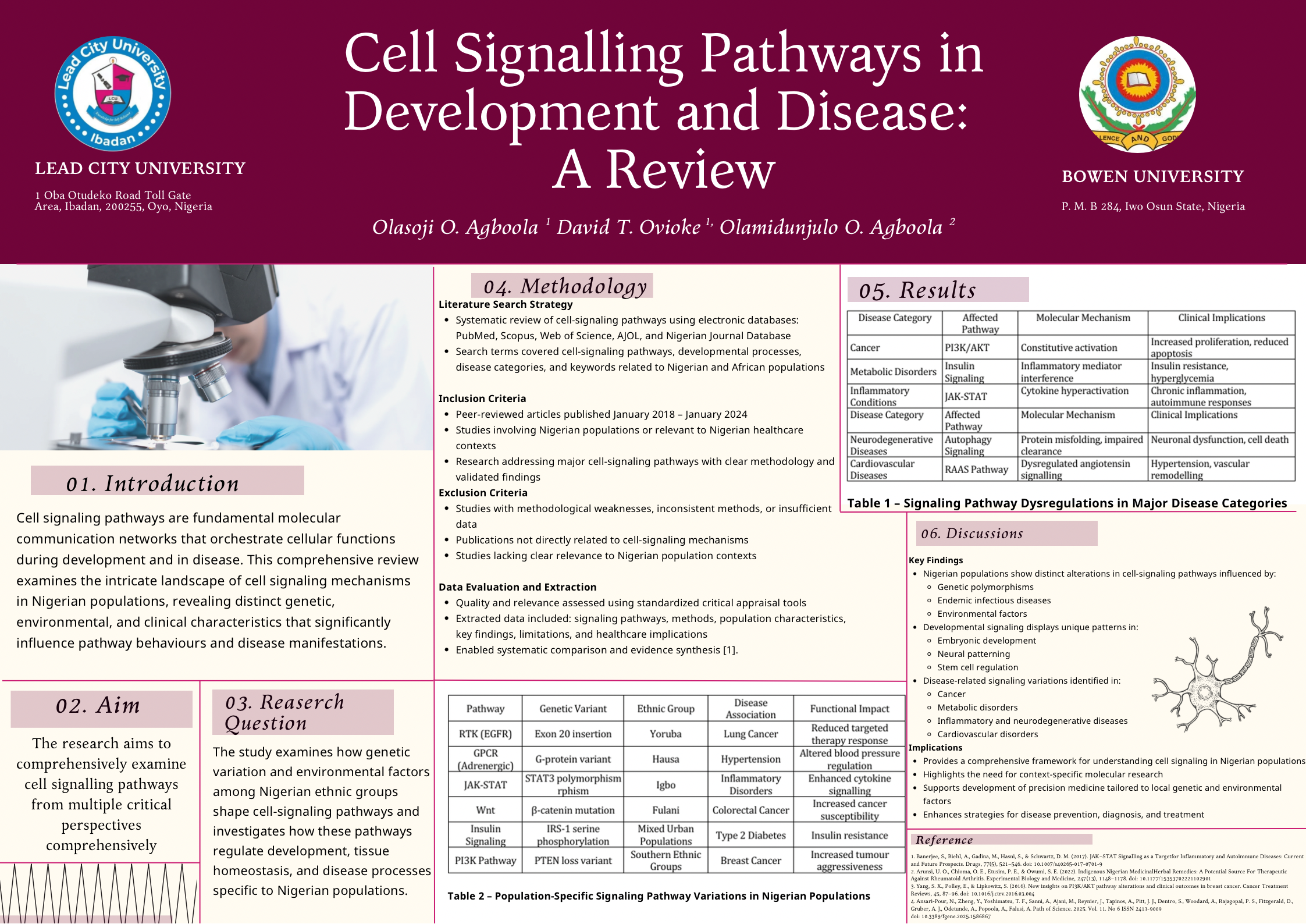
Cell Signalling Pathways in Development and Disease: A Review
Olasoji O. Agboola 1, David T. Ovioke 1
, Olamidunjulo O. Agboola 2
1 Lead City University, Ibadan
1 Oba Otudeko Road Toll Gate Area, Ibadan, 200255, Oyo, Nigeria
2 Bowen University, Iwo
P. M. B 284, Iwo Osun State, Nigeria
Abstract
Background
Cell signalling pathways represent fundamental molecular
communication networks that orchestrate cellular functions in
development and disease. This comprehensive review examines the
intricate landscape of cell signalling mechanisms in Nigerian
populations, revealing distinct genetic, environmental, and clinical
characteristics that significantly influence pathway behaviours and
disease manifestations.
Methods
Through a systematic literature review, we analysed major signalling
pathways, including Receptor Tyrosine Kinase (RTK), G-Protein-Coupled
Receptor (GPCR), JAK-STAT, Wnt, Notch, and Hedgehog signalling,
across both developmental and pathological contexts. Our investigation
uncovered population-specific variations that profoundly impact disease
susceptibility, progression, and treatment responses in Nigerian
healthcare settings.
Results
Key findings demonstrate that Nigerian populations exhibit unique
alterations in signalling pathways driven by genetic polymorphisms,
endemic infectious disease exposures, and environmental factors.
Developmental signalling mechanisms revealed distinctive patterns of
embryonic development, neural patterning, and stem cell regulation. In
disease contexts, significant molecular variations were observed in
cancer, metabolic disorders, inflammatory conditions,
neurodegenerative diseases, and cardiovascular disorders.
The research highlights critical challenges in implementing signalling-
targeted therapies, including infrastructure limitations, economic
constraints, and regulatory complexities. Additionally, traditional
Nigerian medicinal approaches offer promising complementary insights
into the modulation of signalling pathways.
Conclusions
This review establishes a comprehensive framework for understanding
cell signalling pathways in Nigerian populations, emphasising the
importance of contextually specific molecular research. The findings
provide essential guidance for developing precision medicine
approaches tailored to local genetic and environmental contexts,
ultimately supporting more effective disease prevention, diagnosis, and
treatment strategies.
Leave A Comment